Two Executive Pathways

Path 01 Certified Chief Transformation Officer (CTrO)

or

Path 02 Certified Chief AI Officer (CAIO)

Which is your career path?

The two credentials for leaders serious about driving enterprise transformation — and the professionals who are determined to get there.

Each pathway includes four executive certification programmes.

Certified Chief Transformation Officer (CTrO)

Certified Chief AI Officer (CAIO)

Which is Your Career Path?

The two credentials for leaders serious about driving enterprise transformation

— and the professionals who are determined to get there.

Each pathway includes four executive certifications.

Two Executive Pathways

Path 01 Certified Chief Transformation Officer (CTrO)

or

Path 02 Certified Chief AI Officer (CAIO)

Which is your career path?

The two credentials for leaders serious about driving enterprise transformation — and the professionals who are determined to get there.

Each pathway includes four executive certification programmes.

Certified Chief Transformation Officer

Two Executive Pathways

Path 01 Certified Chief Transformation Officer (CTrO)

or

Path 02 Certified Chief AI Officer (CAIO)

Which is your career path?

The two credentials for leaders serious about driving enterprise transformation — and the professionals who are determined to get there.

Each pathway includes four executive certifications.

+

Certified Chief AI Officer

Which One is Your Career Path?

The two credentials for leaders serious about driving enterprise transformation, and the professionals who are determined to get there.

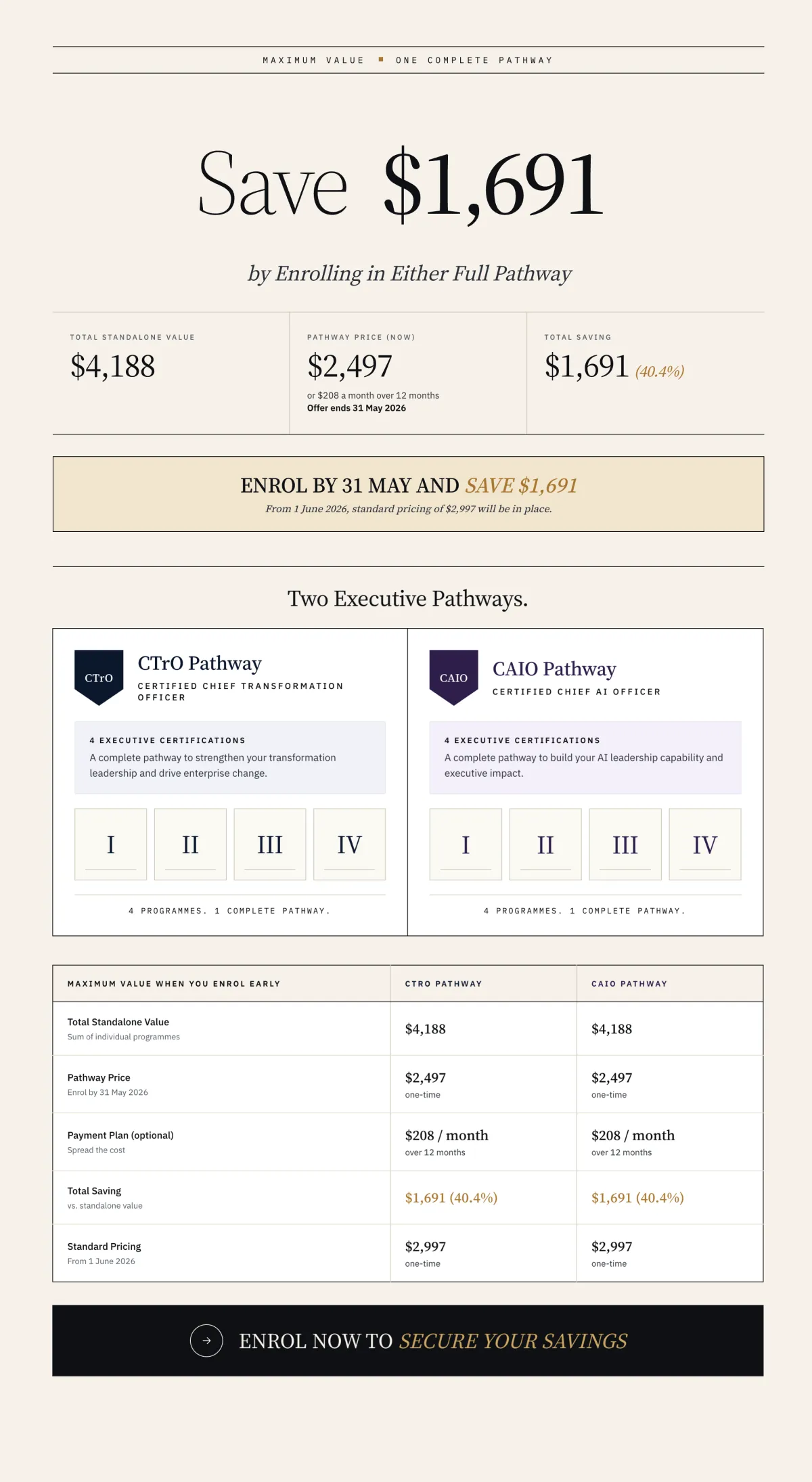
$2,497 When You Enrol in Either Pathway Before June.

Each pathway includes four executive certifications.

Payment plan available at $208/month

Market Brief Executive Leadership · 2026

The Chief Transformation Officer
and Chief AI Officer
have become permanent C-suite roles.

Transformation and AI are now too critical to leave ungoverned.

The CTrO and CAIO are no longer occasional appointments or
extensions of the CIO. They are fixtures.

01 Chief Transformation Officer

These companies have already appointed dedicated transformation leaders, many of whom report directly to the CEO:

  • L'Oréal
  • Microsoft
  • Ericsson
  • Intuit
  • PwC
  • Société Générale
  • Honeywell
  • Goldman Sachs
  • Dell
  • IBM
  • Verizon
  • Chubb
  • GE
  • KPMG
02 Chief AI Officer

On the AI side, organisations are appointing Chief AI Officers to lead enterprise AI strategy, governance, and value creation:

  • Meta
  • Schneider Electric
  • Dell
  • Accenture
  • Nike
  • AXA
  • HSBC
  • Lloyds Banking Group
  • CVS Health
  • SAP
76%
up from 26% a year earlier
IBM Research · Large organisations with a dedicated CAIO
03 The opportunity

Demand for credible, qualified professionals to fill these roles is growing faster than the supply of people equipped to do them.

A clear opening for those prepared to lead enterprise transformation and AI.

These career pathways prepare you to operate as a Chief Transformation Officer or a Chief AI Officer in medium to large organisations.

CXO Transform

Pathway Included 12-Months Access

Executive AI Advisors
— Included for 12 Months

Pathway members receive twelve months of direct access to specialised AI advisors, available to speak with or message at any time. Built exclusively on our proprietary frameworks and trained for the demands of executive leadership, they support strategic thinking, stakeholder engagement, transformation delivery, and career positioning. These are enterprise-trained systems, not generic AI chatbots.

150+ Enterprise & Transformation Roles
40+ Industries Represented
Proprietary Frameworks & Methodology
24/7 Direct Advisor Access
01

Transformation Advisor

Speak with or message your Transformation Advisor to apply frameworks, refine strategic deliverables, and work through complex organisational challenges in real time.

02

Stakeholder Simulator

Speak directly with your Stakeholder Simulator to rehearse executive conversations, stress-test your positioning, and prepare for board-level discussions.

03

Career Strategist

Speak with or message your Career Strategist to strengthen executive positioning, sharpen strategic communication, and accelerate progression into senior leadership.

Speak with or message your advisors, 24 hours a day throughout the pathway.

Designed to accelerate strategic capability, confidence, communication, and professional progression.

Professionals from these organisations participate in CXO Transform programmes.

What CTrO and CAIO Certification Does For You

Become the leader organisations are looking for

Demand for credible transformation and AI leadership is outpacing supply. The CTrO and CAIO designations position you to operate at that level, with the framework, the language, and the credential to support it.

Learn to deliver, not just describe

Strategy is widely discussed but rarely executed well. Whichever pathway you choose, you gain the tools, frameworks, and governance capabilities required to deliver outcomes, not just talk about them.

Lead with a system, not instinct alone

Many transformation and AI professionals rely on experience without a consistent approach. Both pathways give you a structured, repeatable methodology that holds up across organisations and industries.

Earn a credential that travels with you

Unlike internal training that stays within one organisation, your designation is yours permanently. It sits on your LinkedIn profile, your CV, and your professional identity, regardless of where your career takes you.

Gain the confidence to operate at executive level

Whether you are already in a senior role or working toward one, your chosen pathway gives you the governance knowledge, strategic language, and leadership frameworks that executive stakeholders expect.

Invest in yourself on your own terms

No employer approval required. No waiting for training budgets. Enrol and begin building a credential that strengthens your position, at a pace and investment level that works for you.

Increase your market value

Professionals with recognised transformation or AI capability enjoy better roles, higher compensation, and greater influence. The CTrO and CAIO designations signal a level of capability organisations are prepared to pay a premium for.

Learn from a CEO and Fortune 100 Practitioner

This is not academic theory. It is built from real-world enterprise transformation and AI leadership experience at the highest levels. Designed for professionals who want practical capability, not abstract frameworks.

What CTrO and CAIO Certification Does For You

The Outcome

What CTrO and CAIO certification does for you.

Two pathways. One purpose. Equip you with the frameworks, language, confidence, and credentials to lead transformation and AI at the level large organisations are now hiring for.

01

Become the leader organisations are looking for

Demand for credible transformation and AI leadership is outpacing supply. The CTrO and CAIO designations position you to operate at that level — with the frameworks, the language and the credentials to support it.

02

Learn to deliver, not just describe

Strategy is widely discussed but rarely executed well. Whichever pathway you choose, you gain the tools, frameworks and governance capabilities required to deliver outcomes — not just talk about them.

03

Lead with a system, not instinct alone

Many transformation and AI professionals rely on experience without a consistent approach. Both pathways give you a structured, repeatable methodology that holds up across organisations and industries.

04

Earn a credential that travels with you

Unlike internal training that stays within one organisation, your designation is yours permanently. It sits on your LinkedIn profile, your CV and your professional identity, regardless of where your career takes you.

05

Gain the confidence to operate at executive level

Whether you are already in a senior role or working toward one, your chosen pathway gives you the governance knowledge, strategic language and leadership frameworks that executive stakeholders expect.

06

Invest in yourself on your own terms

No employer approval required. No waiting for training budgets. Enrol and begin building a credential that strengthens your position — at a pace and investment level that works for you.

07

Increase your market value

Professionals with recognised transformation or AI capability enjoy better roles, higher compensation and greater influence. The CTrO and CAIO designations signal a level of capability organisations are prepared to pay a premium for.

08

Learn from a CEO and Fortune 100 practitioner

This is not academic theory. It is built from real-world enterprise transformation and AI leadership experience at the highest levels — designed for professionals who want practical capability, not abstract frameworks.

Practical capability. A credential that travels. A pathway built by practitioners.

CTrO  ·  CAIO Certification

Certified Chief Transformation Officer

Four certifications. One complete CTrO credential.

Everything you need for a career leading enterprise transformation.

Certified Transformation Office Leader

Core System

27 Modules (170+ Lessons)

C01: Transformation North Star & Blueprint Governance

• Strategic Rationale

• Complexity Signal

• Diagnostic Self-Assessment

• Installation Prerequisites

• Installation Protocol

• Failure Modes & Resistance

• Success Criteria & Test

• Enterprise Installation Example

Building Your Deliverable

• Blueprint Template

C02: Mandate & Scope Definition

• Strategic Rationale

• Complexity Signal

• Diagnostic Self-Assessment

• Installation Prerequisites

• Installation Protocol

• Failure Modes & Resistance

• Success Criteria & Test

• Enterprise Installation Example

Building Your Deliverable

• Blueprint Template


C03: Executive & Board Sponsorship Model

• Strategic Rationale

• Complexity Signal

• Diagnostic Self-Assessment

• Installation Prerequisites

• Installation Protocol

• Failure Modes & Resistance

• Success Criteria & Test

• Enterprise Installation Example

Building Your Deliverable

• Blueprint Template


C04: Decision Rights & Escalation Architecture

• Strategic Rationale

• Complexity Signal

• Diagnostic Self-Assessment

• Installation Prerequisites

• Installation Protocol

• Failure Modes & Resistance

• Success Criteria & Test

• Enterprise Installation Example

Building Your Deliverable

• Blueprint Template

C05: Financial Authority & Investment Control

• Strategic Rationale

• Complexity Signal

• Diagnostic Self-Assessment

• Installation Prerequisites

• Installation Protocol

• Failure Modes & Resistance

• Success Criteria & Test

• Enterprise Installation Example

Building Your Deliverable

• Blueprint Template

C06: Value Governance & Realisation Assurance

• Strategic Rationale

• Complexity Signal

• Diagnostic Self-Assessment

• Installation Prerequisites

• Installation Protocol

• Failure Modes & Resistance

• Success Criteria & Test

• Enterprise Installation Example

Building Your Deliverable

• Blueprint Template


C07: Transformation Portfolio Logic

• Strategic Rationale

• Complexity Signal

• Diagnostic Self-Assessment

• Installation Prerequisites

• Installation Protocol

• Failure Modes & Resistance

• Success Criteria & Test

• Enterprise Installation Example

Building Your Deliverable

• Blueprint Template


C08: Enterprise Risk & Exposure Governance

• Strategic Rationale

• Complexity Signal

• Diagnostic Self-Assessment

• Installation Prerequisites

• Installation Protocol

• Failure Modes & Resistance

• Success Criteria & Test

• Enterprise Installation Example

Building Your Deliverable

• Blueprint Template


C09: Operating Model & Regulatory Integration

• Strategic Rationale

• Complexity Signal

• Diagnostic Self-Assessment

• Installation Prerequisites

• Installation Protocol

• Failure Modes & Resistance

• Success Criteria & Test

• Enterprise Installation Example

Building Your Deliverable

• Blueprint Template


C10: Technology, Data & Enterprise Architecture Authority

• Strategic Rationale

• Complexity Signal

• Diagnostic Self-Assessment

• Installation Prerequisites

• Installation Protocol

• Failure Modes & Resistance

• Success Criteria & Test

• Enterprise Installation Example

Building Your Deliverable

• Blueprint Template


C11: Cross-Functional Orchestration

• Strategic Rationale

• Complexity Signal

• Diagnostic Self-Assessment

• Installation Prerequisites

• Installation Protocol

• Failure Modes & Resistance

• Success Criteria & Test

• Enterprise Installation Example

Building Your Deliverable

• Blueprint Template


C12: External Interface & Boundary Governance

• Strategic Rationale

• Complexity Signal

• Diagnostic Self-Assessment

• Installation Prerequisites

• Installation Protocol

• Failure Modes & Resistance

• Success Criteria & Test

• Enterprise Installation Example

Building Your Deliverable

• Blueprint Template

C13: Governance Rhythm & Metabolic Discipline

• Strategic Rationale

• Complexity Signal

• Diagnostic Self-Assessment

• Installation Prerequisites

• Installation Protocol

• Failure Modes & Resistance

• Success Criteria & Test

• Enterprise Installation Example

Building Your Deliverable

• Blueprint Template


C14: TMO Leadership & Structural Positioning Architecture

• Strategic Rationale

• Complexity Signal

• Diagnostic Self-Assessment

• Installation Prerequisites

• Installation Protocol

• Failure Modes & Resistance

• Success Criteria & Test

• Enterprise Installation Example

Building Your Deliverable

• Blueprint Template


C15: Intervention Playbooks

• Strategic Rationale

• Complexity Signal

• Diagnostic Self-Assessment

• Installation Prerequisites

• Installation Protocol

• Failure Modes & Resistance

• Success Criteria & Test

• Enterprise Installation Example

Building Your Deliverable

• Blueprint Template


C16: Single Source of Truth & Performance Transparency

• Strategic Rationale

• Complexity Signal

• Diagnostic Self-Assessment

• Installation Prerequisites

• Installation Protocol

• Failure Modes & Resistance

• Success Criteria & Test

• Enterprise Installation Example

Building Your Deliverable

• Blueprint Template


C17: TMO Internal Operating Discipline

• Strategic Rationale

• Complexity Signal

• Diagnostic Self-Assessment

• Installation Prerequisites

• Installation Protocol

• Failure Modes & Resistance

• Success Criteria & Test

• Enterprise Installation Example

Building Your Deliverable

• Blueprint Template


C18: Transformation Talent Architecture

• Strategic Rationale

• Complexity Signal

• Diagnostic Self-Assessment

• Installation Prerequisites

• Installation Protocol

• Failure Modes & Resistance

• Success Criteria & Test

• Enterprise Installation Example

Building Your Deliverable

• Blueprint Template


C19: Institutional Learning & Transformation Memory

• Strategic Rationale

• Complexity Signal

• Diagnostic Self-Assessment

• Installation Prerequisites

• Installation Protocol

• Failure Modes & Resistance

• Success Criteria & Test

• Enterprise Installation Example

Building Your Deliverable

• Blueprint Template


C20: Behavioural, Incentive & Cultural Standards

• Strategic Rationale

• Complexity Signal

• Diagnostic Self-Assessment

• Installation Prerequisites

• Installation Protocol

• Failure Modes & Resistance

• Success Criteria & Test

• Enterprise Installation Example

Building Your Deliverable

• Blueprint Template


C21: Change Capacity & Shock Management

• Strategic Rationale

• Complexity Signal

• Diagnostic Self-Assessment

• Installation Prerequisites

• Installation Protocol

• Failure Modes & Resistance

• Success Criteria & Test

• Enterprise Installation Example

Building Your Deliverable

• Blueprint Template


C22: Leadership Continuity & Authority Revalidation

• Strategic Rationale

• Complexity Signal

• Diagnostic Self-Assessment

• Installation Prerequisites

• Installation Protocol

• Failure Modes & Resistance

• Success Criteria & Test

• Enterprise Installation Example

Building Your Deliverable

• Blueprint Template


C23: Stakeholder & Ecosystem Alignment Architecture

• Strategic Rationale

• Complexity Signal

• Diagnostic Self-Assessment

• Installation Prerequisites

• Installation Protocol

• Failure Modes & Resistance

• Success Criteria & Test

• Enterprise Installation Example

Building Your Deliverable

• Blueprint Template


C24: Steady-State Governance & Compression

• Strategic Rationale

• Complexity Signal

• Diagnostic Self-Assessment

• Installation Prerequisites

• Installation Protocol

• Failure Modes & Resistance

• Success Criteria & Test

• Enterprise Installation Example

Building Your Deliverable

• Blueprint Template


C25: Enterprise Scale & Operating Context Calibration

• Strategic Rationale

• Complexity Signal

• Diagnostic Self-Assessment

• Installation Prerequisites

• Installation Protocol

• Failure Modes & Resistance

• Success Criteria & Test

• Enterprise Installation Example

Building Your Deliverable

• Blueprint Template


C26: Governance Integrity & Structural Durability

• Strategic Rationale

• Complexity Signal

• Diagnostic Self-Assessment

• Installation Prerequisites

• Installation Protocol

• Failure Modes & Resistance

• Success Criteria & Test

• Enterprise Installation Example

Building Your Deliverable

• Blueprint Template


C27: Enterprise Normalisation & Value Permanence

• Strategic Rationale

• Complexity Signal

• Diagnostic Self-Assessment

• Installation Prerequisites

• Installation Protocol

• Failure Modes & Resistance

• Success Criteria & Test

• Enterprise Installation Example

Building Your Deliverable

• Blueprint Template

Leadership Outcomes

The Certified Transformation Office Leader programme enables you to design, build, and run a Transformation Management Office (TMO) in medium to large organisations using the TMO² methodology.

It equips you to govern enterprise transformation across strategy, investment, decision-making, value realisation, operating models, risk, and executive accountability — positioning you far beyond traditional PMO and delivery-management roles.

Participants also build their own TMO Blueprint using our templates, frameworks, and implementation guidance — creating a practical enterprise-ready governance structure that can be adapted to real transformation environments.

Certification

This certification proves that the holder can design, govern, and operationalise enterprise transformation at strategic and boardroom level using the TMO² methodology. These are capabilities increasingly expected of Chief Transformation Officers responsible for transformation governance, value realisation, executive alignment, and enterprise-wide coordination.

• Earn your certification by passing the final exam

• Certificate issued verifiable on the Blockchain

• Your own personal certification page to share

• Unlimited exam re-takes if required

Certified Enterprise Transformation Leader

Specialist System

9 Modules (120+ Lessons)

Meta & Governance Management

• Transformation Governance Structure

• Transformation Office Mandate and Operating Model

• Decision Rights and Arbitration Model

• Portfolio Oversight and Investment Gating

• Risk Management, Compliance, and Regulatory Alignment

• Enterprise Scorecard and Performance Integration


Strategy & Value Management

• Strategic Direction and Ambition Setting

• Business Model Design and Evolution

• Product and Service Portfolio Strategy

• Enterprise Value Definition and KPIs

• Portfolio Prioritisation and Alignment

• Business Case Development and Scenario Planning

• Value Realisation Tracking and Reporting


Customer, Market & Ecosystem Management

• Customer Insights and Journey Mapping

• Product–Market Fit Assessment

• Market Sensing and Competitive Intelligence

• Ecosystem and Partnership Management

• External Stakeholder Engagement (Regulators, Suppliers)

• Continuous Feedback Loops into Strategy and Innovation


Operating Model Management

• Business Process Management

• Organisational Structure and Design

• Governance Model (Roles, Accountabilities, Decision Flows)

• Workforce and Talent Configuration

• Capability Mapping Across Value Streams

• Product Development and Delivery Mechanisms

• Cultural Alignment with the Operating Model


Technology, Data & AI Management

Enterprise Architecture and Platforms

• Cloud, Infrastructure, and Integration

• Data Management and Governance

• AI and Automation Strategy

• Cybersecurity and Resilience

• IT Lifecycle and Service Optimisation

• Technology Portfolio Rationalisation


Innovation & Learning Management

• Enterprise Architecture and Platforms

• Cloud, Infrastructure, and Integration

• Data Management and Governance

• AI and Automation Strategy

• Cybersecurity and Resilience

• IT Lifecycle and Service Optimisation

• Technology Portfolio Rationalisation


Culture, Change & Capability Management

• Culture Definition and Reinforcement

• Behavioural Economics and Incentive Alignment

• Leadership Mindset and Role Modelling

• Stakeholder and Communication Management

• Change Adoption Strategies and Readiness Assessment

• Training, Competence, and Reskilling Programmes

• Change Agent Networks and Capability Maturity


Programme & Project Management

• Programme Governance and PMO Integration

• Project Lifecycle and Delivery Methodologies

• Dependency and Risk Management

• Benefits Tracking and Reporting

• Resource and Capacity Management

• Vendor and Procurement Management

• Escalation and Issue Resolution


Sustainability & ESG Integration

• ESG Strategy Aligned with Enterprise Transformation

• Carbon, Energy, and Resource Efficiency Initiatives

• Diversity, Equity, and Inclusion Programmes

• Regulatory Compliance and Reporting Standards

• Responsible Sourcing and Supply Chain Governance

• Stakeholder Reporting and Transparency

Leadership Outcomes

The Certified Enterprise Transformation Leader programme equips you to design, govern, and align transformation across the entire enterprise using the Enterprise Transformation System (ETS) methodology.

It enables you to integrate strategy, operating models, governance, technology, AI, culture, customer value, innovation, programme delivery, and sustainability into a single transformation architecture — positioning you far beyond siloed transformation, PMO, or change-management approaches.

As you will see from the curriculum, this is not focused on isolated projects or departmental optimisation. It is about orchestrating enterprise transformation as a connected management system across medium to large organisations.

Certification

This certification proves that the holder can align and orchestrate enterprise transformation as an integrated management system using the Enterprise Transformation System (ETS) methodology. These are capabilities expected of Chief Transformation Officers leading complex transformation across strategy, governance, operating models, technology, culture, and value creation.

• Earn your certification by passing the final exam

• Certificate issued verifiable on the Blockchain

• Your own personal certification page to share

• Unlimited exam re-takes if required

Certified Autonomous Business Transformation Leader

Specialist System

8 Modules (80+ Lessons)

The Autonomous Business Imperative

• Why autonomous business is the next disruption

• Autonomy vs automation — the strategic distinction

• Optimisation vs transformation — knowing the difference

• The five waves of business evolution

• Synthetic competition — the new competitive dynamic

• Revenue model disruption — the end of per-seat and per-hour

• What leading organisations are already doing

• The competitive threat of doing nothing

• The window to act


Autonomous Business Transformation (ABT) Framework

• DDA — Diagnose, Decide, Act

• The four transformation dimensions overview

• The Programmable Economy — a new frontier for ABT

• Data loops as competitive moats

• Agentic AI — what every ABT leader must know

• The five maturity levels

• The operating logic of autonomous business

• Responsible AI — the ethical frame for ABT

• The ABT Glossary — owning the language

• Applying the framework across roles


The Four Transformation Dimensions in Depth

• Autonomous Operations — the shift to machine-led execution

• Autonomous Operations in practice — financial services and logistics

• Augmented Workforce — human-AI teaming

• Augmented Workforce in practice — professional services and manufacturing

• Auto-Adapting Products — building products that learn

• Auto-Adapting Products in practice — retail and healthcare

• Machine Customers — designing for machine-to-machine commerce

• Agent identity and trust infrastructure

• Machine Customers in practice — B2B commerce and the platform economy


Diagnose

• Conducting an ABT Diagnostic

• Facilitating the diagnostic with stakeholders

• Assessing the four transformation dimensions

• The ABT Maturity Assessment tool

• Benchmarking — reading the external landscape

• Gap analysis — current state vs autonomous ambition

• Leadership readiness assessment

• Assessing data readiness for autonomy

• Presenting findings to the C-suite and board


Decide

• Setting the autonomous business ambition

• Sequencing autonomy — islands, domains, enterprise redesign

• What good looks like — defining the target state

• Aligning the C-suite — vision, roles and decision rights

• The CAIO role and the CTrO-CAIO relationship

• Building the AI governance framework

• The ABT risk landscape — model risk, liability and regulation

• Agentic risk

• Sector-specific AI regulation

• Building the ABT business case

• Navigating the AI vendor landscape — build, partner or buy

• Competitive positioning in an autonomous market

• Prioritising the four transformation dimensions

• Building and presenting the transformation roadmap


Act

• Operating model redesign — and orchestrating the agent fleet

• Workforce readiness — assessment and programme design

• Workforce redesign — rearchitecting roles

• Deploying autonomous operations — where to start

• Scaling from pilot to enterprise

• Quick wins vs long-term transformation

• Working with technical teams — the ABT leader’s role

• The Enterprise Transformation System

• The ABT metrics framework

• Sustaining momentum

• Closing the deployment gap

• Avoiding common failure modes

• Operational resilience

• Running the autonomous business


Leading ABT in Practice

• Structuring an ABT engagement or programme

• Making the case to a sceptical board

• Managing the human impact of autonomous change

• When transformation stalls — diagnosis and recovery

• Monitoring the autonomous competitive landscape

• The autonomous business leader — redefining your role

• Building personal AI fluency

• Ethical leadership in an autonomous business

• Building your ABT practice


Capstone: The ABT Leadership Challenge

• The challenge brief — scenario, rules and assessment criteria

• Conducting the diagnostic

• Developing the strategy and ambition

• Building the roadmap and business case

• Board presentation — making the ABT case

• Panel review and certification

Leadership Outcomes

The Certified Autonomous Business Transformation Leader programme equips you to help organisations transition from traditional operating models towards more autonomous, adaptive, and AI-driven business systems using the Autonomous Business Transformation (ABT) framework.

It enables you to redesign business operations, workforce models, products, services, decision structures, and value creation mechanisms around agentic AI, autonomous operations, and machine-enabled business capabilities.

This is not about isolated automation projects or deploying AI tools in silos. It is about helping businesses remain competitive as autonomous business models increasingly reshape industries, operating economics, customer expectations, and enterprise strategy.

Certification

This certification proves that the holder can lead and govern autonomous business transformation across agentic AI, autonomous operations, augmented workforces, and machine-driven business models using the ABT framework. These are capabilities increasingly relevant to Chief Transformation Officers leading AI-driven enterprise redesign, especially as 80% of executives expect autonomous business to become the dominant operating model by 2030.

• Earn certification by passing the final exam

• Certificate issued verifiable on the Blockchain

• Your own personal certification page to share

• Unlimited exam re-takes if required

Certified Business Model Transformation Strategist

Specialist System

11 Modules (130+ Lessons)

Ultimate Business Transformation

• Strategic Business Direction

• Business Transformation

• Innovation Potential and Complexity

• Types of Business Model

• Disruption & Industry Trends

• About Disruption

• Theories of Disruption

• Types of Disruption

• Identifying Potential Disruptions


Emerging Industry Trends

• Impact of Trends on Business Models

• Market Shifts and their Effects

• Strategies for Staying Ahead

• Cultural and Ethical Considerations

• Case Studies


Business Model Innovation

• Definitions

• Identifying Opportunities For Innovation

• Design Thinking

• Lean Startup Approach

• Blue Ocean Strategy

• Collaboration And Co-Creation

• Utilising Technology

• Real World Examples and Case Studies


Business Model Canvas

• Introduction

• Customer Segments

• Value Proposition

• Channels

• Customer Relationships

• Revenue Streams

• Key Resources

• Key Activities

• Key Partnerships

• Cost Structure

• Application and Practical Exercises

• Business Model Canvas Alternatives

• Business Model Case Studies


Case Studies and Best Practices

• Amazon’s Business Model Overview

• IKEA’s Business Model Overview

• Disney’s Business Model Overview


Tech Enabled Business Models

• Understanding Emerging Technologies

• Assessing Technology Impact

• Innovative Application

• Competitive Advantage

• Risk Assessment

• Mobile: About These Business Models

• Mobile: Business Model Ideas

• Mobile: Branch International Business Model

• Mobile: Uber Business Model

• Mobile: Yoox Net-A-Porter Business Model

• AI: About These Business Models

• AI: Business Model Ideas

• AI: Netflix Business Model

• AI: Vicarious Business Model

• AI: NVIDIA Business Model

• IoT: About These Business Models

• IoT: Business Model Ideas

• IoT: John Deere Business Model

• IoT: Telit Business Model

• IoT: Xively Business Model

• Cloud: About These Business Models

• Cloud: Business Model Ideas

• Cloud: CloudMinds Business Model

• Cloud: OVHcloud Business Model

• Cloud: Salesforce Business Model

• Digital Twin: About These Business Models

• Digital Twin: Business Model Ideas

• Digital Twin: Aker Solutions Business Model

• Digital Twin: GE Aviation Business Model

• Digital Twin: PTC Business Model


Market Analysis & Customer Focus

• Understanding Market Dynamics

• Competitor Analysis

• Value Proposition Development

• Designing with the Customer in Mind

• PESTEL Analysis

• Customer Pain Points

• Feedback and Adaptation

• Trend Identification

• Customer Needs and Preferences


Project Exercises

• About These Project Exercises

• Project 1: Business Model Innovation

• Project 2: Business Model Evolution

• Project 3: Strategic Star Alignment


Business Model Financials

• Building a Financial Model

• Revenue Streams

• Cost Structure

• Break-Even Analysis

• Sensitivity Analysis

• Viability Assessment

• Sustainability Considerations

• Risk Management

• Funding Requirements

• Scalability and Growth Projections


Scaling & Global Expansion

• Understanding Scaling

• Business Model Adaptation

• Use of Technology

• Resource Management

• Market Expansion Strategies

• Cultural Sensitivity

• Regulatory Compliance

• Market Research

• Risk Management

• Localisation vs. Standardisation


More Tech Enabled Business Models

• Robotics: About These Business Models

• Robotics: Business Model Ideas

• Robotics: Boston Dynamics Business Model

• Robotics: KUKA Business Model

• Robotics: Rethink Business Model

• VR: About These Business Models

• VR: Business Model Ideas

• VR: IMAX Business Model

• VR: NextVR Business Model

• VR: The VOID Business Model

• Machine Learning: About These Business Models

• Machine Learning: Business Model Ideas

• Machine Learning: Alphalake AI Business Model

• Machine Learning: H20.ai Business Model

• Machine Learning: Nutonomy Business Model

• Big Data Analytics: About These Business Models

• Big Data Analytics: Business Model Ideas

• Big Data Analytics: Cloudera Business Model

• Big Data Analytics: Palantir Business Model

• Big Data Analytics: Splunk Business Model

• RPA: About These Business Models

• RPA: Business Model Ideas

• RPA: Automation Anywhere Business Model

• RPA: Kofax Business Model

• RPA: WorkFusion Business Model

Leadership Outcomes

The Certified Business Model Transformation Strategist programme equips you to redesign, evolve, and reinvent business models in response to disruption, emerging technologies, changing customer behaviour, and shifting market dynamics.

It enables you to identify transformation opportunities, evaluate technology-enabled business models, and design commercially viable strategies for growth, scalability, competitive advantage, and long-term relevance.

The programme develops your ability to think strategically about how organisations create value, compete, adapt, monetise innovation, and respond to accelerating technological and market change.

Certification

This certification proves that the holder can redesign and evolve business models in response to disruption, emerging technologies, and changing market conditions. These are capabilities highly relevant to Chief Transformation Officers responsible for enterprise adaptation, competitiveness, and long-term strategic relevance.

• Earn your certification by passing the final exam

• Certificate issued verifiable on the Blockchain

• Your own personal certification page to share

• Unlimited exam re-takes if required

Complete all four certifications to earn the full CTrO designation.

Certified Chief Transformation Officer

Four certifications. One complete CTrO credential.

Everything you need for a career leading enterprise transformation.

Certified Transformation Office Leader

Core System

27 Modules (170+ Lessons)

C01: Transformation North Star & Blueprint Governance

• Strategic Rationale

• Complexity Signal

• Diagnostic Self-Assessment

• Installation Prerequisites

• Installation Protocol

• Failure Modes & Resistance

• Success Criteria & Test

• Enterprise Installation Example

Building Your Deliverable

• Blueprint Template


C02: Mandate & Scope Definition

• Strategic Rationale

• Complexity Signal

• Diagnostic Self-Assessment

• Installation Prerequisites

• Installation Protocol

• Failure Modes & Resistance

• Success Criteria & Test

• Enterprise Installation Example

Building Your Deliverable

• Blueprint Template


C03: Executive & Board Sponsorship Model

• Strategic Rationale

• Complexity Signal

• Diagnostic Self-Assessment

• Installation Prerequisites

• Installation Protocol

• Failure Modes & Resistance

• Success Criteria & Test

• Enterprise Installation Example

Building Your Deliverable

• Blueprint Template


C04: Decision Rights & Escalation Architecture

• Strategic Rationale

• Complexity Signal

• Diagnostic Self-Assessment

• Installation Prerequisites

• Installation Protocol

• Failure Modes & Resistance

• Success Criteria & Test

• Enterprise Installation Example

Building Your Deliverable

• Blueprint Template


C05: Financial Authority & Investment Control

• Strategic Rationale

• Complexity Signal

• Diagnostic Self-Assessment

• Installation Prerequisites

• Installation Protocol

• Failure Modes & Resistance

• Success Criteria & Test

• Enterprise Installation Example

Building Your Deliverable

• Blueprint Template


C06: Value Governance & Realisation Assurance

• Strategic Rationale

• Complexity Signal

• Diagnostic Self-Assessment

• Installation Prerequisites

• Installation Protocol

• Failure Modes & Resistance

• Success Criteria & Test

• Enterprise Installation Example

Building Your Deliverable

• Blueprint Template


C07: Transformation Portfolio Logic

• Strategic Rationale

• Complexity Signal

• Diagnostic Self-Assessment

• Installation Prerequisites

• Installation Protocol

• Failure Modes & Resistance

• Success Criteria & Test

• Enterprise Installation Example

Building Your Deliverable

• Blueprint Template


C08: Enterprise Risk & Exposure Governance

• Strategic Rationale

• Complexity Signal

• Diagnostic Self-Assessment

• Installation Prerequisites

• Installation Protocol

• Failure Modes & Resistance

• Success Criteria & Test

• Enterprise Installation Example

Building Your Deliverable

• Blueprint Template


C09: Operating Model & Regulatory Integration

• Strategic Rationale

• Complexity Signal

• Diagnostic Self-Assessment

• Installation Prerequisites

• Installation Protocol

• Failure Modes & Resistance

• Success Criteria & Test

• Enterprise Installation Example

Building Your Deliverable

• Blueprint Template


C10: Technology, Data & Enterprise Architecture Authority

• Strategic Rationale

• Complexity Signal

• Diagnostic Self-Assessment

• Installation Prerequisites

• Installation Protocol

• Failure Modes & Resistance

• Success Criteria & Test

• Enterprise Installation Example

Building Your Deliverable

• Blueprint Template


C11: Cross-Functional Orchestration

• Strategic Rationale

• Complexity Signal

• Diagnostic Self-Assessment

• Installation Prerequisites

• Installation Protocol

• Failure Modes & Resistance

• Success Criteria & Test

• Enterprise Installation Example

Building Your Deliverable

• Blueprint Template


C12: External Interface & Boundary Governance

• Strategic Rationale

• Complexity Signal

• Diagnostic Self-Assessment

• Installation Prerequisites

• Installation Protocol

• Failure Modes & Resistance

• Success Criteria & Test

• Enterprise Installation Example

Building Your Deliverable

• Blueprint Template


C13: Governance Rhythm & Metabolic Discipline

• Strategic Rationale

• Complexity Signal

• Diagnostic Self-Assessment

• Installation Prerequisites

• Installation Protocol

• Failure Modes & Resistance

• Success Criteria & Test

• Enterprise Installation Example

Building Your Deliverable

• Blueprint Template


C14: TMO Leadership & Structural Positioning Architecture

• Strategic Rationale

• Complexity Signal

• Diagnostic Self-Assessment

• Installation Prerequisites

• Installation Protocol

• Failure Modes & Resistance

• Success Criteria & Test

• Enterprise Installation Example

Building Your Deliverable

• Blueprint Template


C15: Intervention Playbooks

• Strategic Rationale

• Complexity Signal

• Diagnostic Self-Assessment

• Installation Prerequisites

• Installation Protocol

• Failure Modes & Resistance

• Success Criteria & Test

• Enterprise Installation Example

Building Your Deliverable

• Blueprint Template


C16: Single Source of Truth & Performance Transparency

• Strategic Rationale

• Complexity Signal

• Diagnostic Self-Assessment

• Installation Prerequisites

• Installation Protocol

• Failure Modes & Resistance

• Success Criteria & Test

• Enterprise Installation Example

Building Your Deliverable

• Blueprint Template


C17: TMO Internal Operating Discipline

• Strategic Rationale

• Complexity Signal

• Diagnostic Self-Assessment

• Installation Prerequisites

• Installation Protocol

• Failure Modes & Resistance

• Success Criteria & Test

• Enterprise Installation Example

Building Your Deliverable

• Blueprint Template


C18: Transformation Talent Architecture

• Strategic Rationale

• Complexity Signal

• Diagnostic Self-Assessment

• Installation Prerequisites

• Installation Protocol

• Failure Modes & Resistance

• Success Criteria & Test

• Enterprise Installation Example

Building Your Deliverable

• Blueprint Template


C19: Institutional Learning & Transformation Memory

• Strategic Rationale

• Complexity Signal

• Diagnostic Self-Assessment

• Installation Prerequisites

• Installation Protocol

• Failure Modes & Resistance

• Success Criteria & Test

• Enterprise Installation Example

Building Your Deliverable

• Blueprint Template


C20: Behavioural, Incentive & Cultural Standards

• Strategic Rationale

• Complexity Signal

• Diagnostic Self-Assessment

• Installation Prerequisites

• Installation Protocol

• Failure Modes & Resistance

• Success Criteria & Test

• Enterprise Installation Example

Building Your Deliverable

• Blueprint Template


C21: Change Capacity & Shock Management

• Strategic Rationale

• Complexity Signal

• Diagnostic Self-Assessment

• Installation Prerequisites

• Installation Protocol

• Failure Modes & Resistance

• Success Criteria & Test

• Enterprise Installation Example

Building Your Deliverable

• Blueprint Template


C22: Leadership Continuity & Authority Revalidation

• Strategic Rationale

• Complexity Signal

• Diagnostic Self-Assessment

• Installation Prerequisites

• Installation Protocol

• Failure Modes & Resistance

• Success Criteria & Test

• Enterprise Installation Example

Building Your Deliverable

• Blueprint Template


C23: Stakeholder & Ecosystem Alignment Architecture

• Strategic Rationale

• Complexity Signal

• Diagnostic Self-Assessment

• Installation Prerequisites

• Installation Protocol

• Failure Modes & Resistance

• Success Criteria & Test

• Enterprise Installation Example

Building Your Deliverable

• Blueprint Template


C24: Steady-State Governance & Compression

• Strategic Rationale

• Complexity Signal

• Diagnostic Self-Assessment

• Installation Prerequisites

• Installation Protocol

• Failure Modes & Resistance

• Success Criteria & Test

• Enterprise Installation Example

Building Your Deliverable

• Blueprint Template


C25: Enterprise Scale & Operating Context Calibration

• Strategic Rationale

• Complexity Signal

• Diagnostic Self-Assessment

• Installation Prerequisites

• Installation Protocol

• Failure Modes & Resistance

• Success Criteria & Test

• Enterprise Installation Example

Building Your Deliverable

• Blueprint Template


C26: Governance Integrity & Structural Durability

• Strategic Rationale

• Complexity Signal

• Diagnostic Self-Assessment

• Installation Prerequisites

• Installation Protocol

• Failure Modes & Resistance

• Success Criteria & Test

• Enterprise Installation Example

Building Your Deliverable

• Blueprint Template


C27: Enterprise Normalisation & Value Permanence

• Strategic Rationale

• Complexity Signal

• Diagnostic Self-Assessment

• Installation Prerequisites

• Installation Protocol

• Failure Modes & Resistance

• Success Criteria & Test

• Enterprise Installation Example

Building Your Deliverable

• Blueprint Template

Leadership Outcomes

The Certified Transformation Office Leader programme enables you to design, build, and run a Transformation Management Office (TMO) in medium to large organisations using the TMO² methodology.

It equips you to govern enterprise transformation across strategy, investment, decision-making, value realisation, operating models, risk, and executive accountability — positioning you far beyond traditional PMO and delivery-management roles.

Participants also build their own TMO Blueprint using our templates, frameworks, and implementation guidance — creating a practical enterprise-ready governance structure that can be adapted to real transformation environments.

Certification

This certification proves that the holder can design, govern, and operationalise enterprise transformation at strategic and boardroom level using the TMO² methodology. These are capabilities increasingly expected of Chief Transformation Officers responsible for transformation governance, value realisation, executive alignment, and enterprise-wide coordination.

• Earn your certification by passing the final exam

• Certificate issued verifiable on the Blockchain

• Your own personal certification page to share

• Unlimited exam re-takes if required

Delivery & Access

• This is a self-paced, online programme

• You get 5 years access

• Structured for real-world application

When you pay in full up-front

• You get immediate access to everything

When you opt for the 12-month payment plan

• You get phased access to modules over 12 months

Certified Enterprise Transformation Leader

Specialist System

9 Modules (120+ Lessons)

Meta & Governance Management

• Transformation Governance Structure

• Transformation Office Mandate and Operating Model

• Decision Rights and Arbitration Model

• Portfolio Oversight and Investment Gating

• Risk Management, Compliance, and Regulatory Alignment

• Enterprise Scorecard and Performance Integration


Strategy & Value Management

• Strategic Direction and Ambition Setting

• Business Model Design and Evolution

• Product and Service Portfolio Strategy

• Enterprise Value Definition and KPIs

• Portfolio Prioritisation and Alignment

• Business Case Development and Scenario Planning

• Value Realisation Tracking and Reporting


Customer, Market & Ecosystem Management

• Customer Insights and Journey Mapping

• Product–Market Fit Assessment

• Market Sensing and Competitive Intelligence

• Ecosystem and Partnership Management

• External Stakeholder Engagement (Regulators, Suppliers)

• Continuous Feedback Loops into Strategy and Innovation


Operating Model Management

• Business Process Management

• Organisational Structure and Design

• Governance Model (Roles, Accountabilities, Decision Flows)

• Workforce and Talent Configuration

• Capability Mapping Across Value Streams

• Product Development and Delivery Mechanisms

• Cultural Alignment with the Operating Model


Technology, Data & AI Management

Enterprise Architecture and Platforms

• Cloud, Infrastructure, and Integration

• Data Management and Governance

• AI and Automation Strategy

• Cybersecurity and Resilience

• IT Lifecycle and Service Optimisation

• Technology Portfolio Rationalisation


Innovation & Learning Management

• Enterprise Architecture and Platforms

• Cloud, Infrastructure, and Integration

• Data Management and Governance

• AI and Automation Strategy

• Cybersecurity and Resilience

• IT Lifecycle and Service Optimisation

• Technology Portfolio Rationalisation


Culture, Change & Capability Management

• Culture Definition and Reinforcement

• Behavioural Economics and Incentive Alignment

• Leadership Mindset and Role Modelling

• Stakeholder and Communication Management

• Change Adoption Strategies and Readiness Assessment

• Training, Competence, and Reskilling Programmes

• Change Agent Networks and Capability Maturity


Programme & Project Management

• Programme Governance and PMO Integration

• Project Lifecycle and Delivery Methodologies

• Dependency and Risk Management

• Benefits Tracking and Reporting

• Resource and Capacity Management

• Vendor and Procurement Management

• Escalation and Issue Resolution


Sustainability & ESG Integration

• ESG Strategy Aligned with Enterprise Transformation

• Carbon, Energy, and Resource Efficiency Initiatives

• Diversity, Equity, and Inclusion Programmes

• Regulatory Compliance and Reporting Standards

• Responsible Sourcing and Supply Chain Governance

• Stakeholder Reporting and Transparency

Leadership Outcomes

The Certified Enterprise Transformation Leader programme equips you to design, govern, and align transformation across the entire enterprise using the Enterprise Transformation System (ETS) methodology.

It enables you to integrate strategy, operating models, governance, technology, AI, culture, customer value, innovation, programme delivery, and sustainability into a single transformation architecture — positioning you far beyond siloed transformation, PMO, or change-management approaches.

As you will see from the curriculum, this is not focused on isolated projects or departmental optimisation. It is about orchestrating enterprise transformation as a connected management system across medium to large organisations.

Certification

This certification proves that the holder can align and orchestrate enterprise transformation as an integrated management system using the Enterprise Transformation System (ETS) methodology. These are capabilities expected of Chief Transformation Officers leading complex transformation across strategy, governance, operating models, technology, culture, and value creation.

• Earn your certification by passing the final exam

• Certificate issued verifiable on the Blockchain

• Your own personal certification page to share

• Unlimited exam re-takes if required

Delivery & Access

• This is a self-paced, online programme

• You get 5 years access

• Structured for real-world application

When you pay in full up-front

• You get access to everything on 15 June 2026

When you opt for the 12-month payment plan

• You start getting access on 15 June 2026

• You get phased access to modules over 12 months

Certified Autonomous Business Transformation Leader

Specialist System

8 Modules (80+ Lessons)

The Autonomous Business Imperative

• Why autonomous business is the next disruption

• Autonomy vs automation — the strategic distinction

• Optimisation vs transformation — knowing the difference

• The five waves of business evolution

• Synthetic competition — the new competitive dynamic

• Revenue model disruption — the end of per-seat and per-hour

• What leading organisations are already doing

• The competitive threat of doing nothing

• The window to act


Autonomous Business Transformation (ABT) Framework

• DDA — Diagnose, Decide, Act

• The four transformation dimensions overview

• The Programmable Economy — a new frontier for ABT

• Data loops as competitive moats

• Agentic AI — what every ABT leader must know

• The five maturity levels

• The operating logic of autonomous business

• Responsible AI — the ethical frame for ABT

• The ABT Glossary — owning the language

• Applying the framework across roles


The Four Transformation Dimensions in Depth

• Autonomous Operations — the shift to machine-led execution

• Autonomous Operations in practice — financial services and logistics

• Augmented Workforce — human-AI teaming

• Augmented Workforce in practice — professional services and manufacturing

• Auto-Adapting Products — building products that learn

• Auto-Adapting Products in practice — retail and healthcare

• Machine Customers — designing for machine-to-machine commerce

• Agent identity and trust infrastructure

• Machine Customers in practice — B2B commerce and the platform economy


Diagnose

• Conducting an ABT Diagnostic

• Facilitating the diagnostic with stakeholders

• Assessing the four transformation dimensions

• The ABT Maturity Assessment tool

• Benchmarking — reading the external landscape

• Gap analysis — current state vs autonomous ambition

• Leadership readiness assessment

• Assessing data readiness for autonomy

• Presenting findings to the C-suite and board


Decide

• Setting the autonomous business ambition

• Sequencing autonomy — islands, domains, enterprise redesign

• What good looks like — defining the target state

• Aligning the C-suite — vision, roles and decision rights

• The CAIO role and the CTrO-CAIO relationship

• Building the AI governance framework

• The ABT risk landscape — model risk, liability and regulation

• Agentic risk

• Sector-specific AI regulation

• Building the ABT business case

• Navigating the AI vendor landscape — build, partner or buy

• Competitive positioning in an autonomous market

• Prioritising the four transformation dimensions

• Building and presenting the transformation roadmap


Act

• Operating model redesign — and orchestrating the agent fleet

• Workforce readiness — assessment and programme design

• Workforce redesign — rearchitecting roles

• Deploying autonomous operations — where to start

• Scaling from pilot to enterprise

• Quick wins vs long-term transformation

• Working with technical teams — the ABT leader’s role

• The Enterprise Transformation System

• The ABT metrics framework

• Sustaining momentum

• Closing the deployment gap

• Avoiding common failure modes

• Operational resilience

• Running the autonomous business


Leading ABT in Practice

• Structuring an ABT engagement or programme

• Making the case to a sceptical board

• Managing the human impact of autonomous change

• When transformation stalls — diagnosis and recovery

• Monitoring the autonomous competitive landscape

• The autonomous business leader — redefining your role

• Building personal AI fluency

• Ethical leadership in an autonomous business

• Building your ABT practice


Capstone: The ABT Leadership Challenge

• The challenge brief — scenario, rules and assessment criteria

• Conducting the diagnostic

• Developing the strategy and ambition

• Building the roadmap and business case

• Board presentation — making the ABT case

• Panel review and certification

Leadership Outcomes

The Certified Autonomous Business Transformation Leader programme equips you to help organisations transition from traditional operating models towards more autonomous, adaptive, and AI-driven business systems using the Autonomous Business Transformation (ABT) framework.

It enables you to redesign business operations, workforce models, products, services, decision structures, and value creation mechanisms around agentic AI, autonomous operations, and machine-enabled business capabilities.

This is not about isolated automation projects or deploying AI tools in silos. It is about helping businesses remain competitive as autonomous business models increasingly reshape industries, operating economics, customer expectations, and enterprise strategy.

Certification

This certification proves that the holder can lead and govern autonomous business transformation across agentic AI, autonomous operations, augmented workforces, and machine-driven business models using the ABT framework. These are capabilities increasingly relevant to Chief Transformation Officers leading AI-driven enterprise redesign, especially as 80% of executives expect autonomous business to become the dominant operating model by 2030.

• Earn certification by passing the final exam

• Certificate issued verifiable on the Blockchain

• Your own personal certification page to share

• Unlimited exam re-takes if required

Delivery & Access

• This is a self-paced, online programme

• You get 5 years access

• Structured for real-world application

When you pay in full up-front

• Start getting access to modules on 1 August 2026

• Get access to all 8 modules over 4 months (2 modules per month)

When you opt for the 12-month payment plan

• You start getting access on 1 August 2026

• You get phased access to modules over 12 months

Certified Business Model Transformation Strategist

Specialist System

11 Modules (130+ Lessons)

Ultimate Business Transformation

• Strategic Business Direction

• Business Transformation

• Innovation Potential and Complexity

• Types of Business Model

• Disruption & Industry Trends

• About Disruption

• Theories of Disruption

• Types of Disruption

• Identifying Potential Disruptions


Emerging Industry Trends

• Impact of Trends on Business Models

• Market Shifts and their Effects

• Strategies for Staying Ahead

• Cultural and Ethical Considerations

• Case Studies


Business Model Innovation

• Definitions

• Identifying Opportunities For Innovation

• Design Thinking

• Lean Startup Approach

• Blue Ocean Strategy

• Collaboration And Co-Creation

• Utilising Technology

• Real World Examples and Case Studies


Business Model Canvas

• Introduction

• Customer Segments

• Value Proposition

• Channels

• Customer Relationships

• Revenue Streams

• Key Resources

• Key Activities

• Key Partnerships

• Cost Structure

• Application and Practical Exercises

• Business Model Canvas Alternatives

• Business Model Case Studies


Case Studies and Best Practices

• Amazon’s Business Model Overview

• IKEA’s Business Model Overview

• Disney’s Business Model Overview


Tech Enabled Business Models

• Understanding Emerging Technologies

• Assessing Technology Impact

• Innovative Application

• Competitive Advantage

• Risk Assessment

• Mobile: About These Business Models

• Mobile: Business Model Ideas

• Mobile: Branch International Business Model

• Mobile: Uber Business Model

• Mobile: Yoox Net-A-Porter Business Model

• AI: About These Business Models

• AI: Business Model Ideas

• AI: Netflix Business Model

• AI: Vicarious Business Model

• AI: NVIDIA Business Model

• IoT: About These Business Models

• IoT: Business Model Ideas

• IoT: John Deere Business Model

• IoT: Telit Business Model

• IoT: Xively Business Model

• Cloud: About These Business Models

• Cloud: Business Model Ideas

• Cloud: CloudMinds Business Model

• Cloud: OVHcloud Business Model

• Cloud: Salesforce Business Model

• Digital Twin: About These Business Models

• Digital Twin: Business Model Ideas

• Digital Twin: Aker Solutions Business Model

• Digital Twin: GE Aviation Business Model

• Digital Twin: PTC Business Model


Market Analysis & Customer Focus

• Understanding Market Dynamics

• Competitor Analysis

• Value Proposition Development

• Designing with the Customer in Mind

• PESTEL Analysis

• Customer Pain Points

• Feedback and Adaptation

• Trend Identification

• Customer Needs and Preferences


Project Exercises

• About These Project Exercises

• Project 1: Business Model Innovation

• Project 2: Business Model Evolution

• Project 3: Strategic Star Alignment


Business Model Financials

• Building a Financial Model

• Revenue Streams

• Cost Structure

• Break-Even Analysis

• Sensitivity Analysis

• Viability Assessment

• Sustainability Considerations

• Risk Management

• Funding Requirements

• Scalability and Growth Projections


Scaling & Global Expansion

• Understanding Scaling

• Business Model Adaptation

• Use of Technology

• Resource Management

• Market Expansion Strategies

• Cultural Sensitivity

• Regulatory Compliance

• Market Research

• Risk Management

• Localisation vs. Standardisation


More Tech Enabled Business Models

• Robotics: About These Business Models

• Robotics: Business Model Ideas

• Robotics: Boston Dynamics Business Model

• Robotics: KUKA Business Model

• Robotics: Rethink Business Model

• VR: About These Business Models

• VR: Business Model Ideas

• VR: IMAX Business Model

• VR: NextVR Business Model

• VR: The VOID Business Model

• Machine Learning: About These Business Models

• Machine Learning: Business Model Ideas

• Machine Learning: Alphalake AI Business Model

• Machine Learning: H20.ai Business Model

• Machine Learning: Nutonomy Business Model

• Big Data Analytics: About These Business Models

• Big Data Analytics: Business Model Ideas

• Big Data Analytics: Cloudera Business Model

• Big Data Analytics: Palantir Business Model

• Big Data Analytics: Splunk Business Model

• RPA: About These Business Models

• RPA: Business Model Ideas

• RPA: Automation Anywhere Business Model

• RPA: Kofax Business Model

• RPA: WorkFusion Business Model

Leadership Outcomes

The Certified Business Model Transformation Strategist programme equips you to redesign, evolve, and reinvent business models in response to disruption, emerging technologies, changing customer behaviour, and shifting market dynamics.

It enables you to identify transformation opportunities, evaluate technology-enabled business models, and design commercially viable strategies for growth, scalability, competitive advantage, and long-term relevance.

The programme develops your ability to think strategically about how organisations create value, compete, adapt, monetise innovation, and respond to accelerating technological and market change.

Certification

This certification proves that the holder can redesign and evolve business models in response to disruption, emerging technologies, and changing market conditions. These are capabilities highly relevant to Chief Transformation Officers responsible for enterprise adaptation, competitiveness, and long-term strategic relevance.

• Earn your certification by passing the final exam

• Certificate issued verifiable on the Blockchain

• Your own personal certification page to share

• Unlimited exam re-takes if required

Delivery & Access

• This is a self-paced, online programme

• You get 5 years access

• Structured for real-world application

When you pay in full up-front

• You get immediate access to everything

When you opt for the 12-month payment plan

• You get phased access to modules over 12 months

Complete all four certifications to earn the full CTrO designation.

Certified Chief AI Officer

Four certifications. One complete CAIO credential.

Everything you need for a career leading enterprise AI.

Certified AI Strategy & Implementation Leader

Core System

10 Modules (100+ Lessons)

Module 1 — AI Strategy Development

• Introduction to AI Strategy

• Competitive Analysis and Market Positioning with AI

• Defining AI Vision and Objectives

• Evaluating AI Opportunities Across the Organisation

• AI Investment Prioritisation

• Creating a Roadmap for AI Initiatives

• Balancing Short-Term Wins and Long-Term AI Goals

• Building Stakeholder Buy-In for AI Strategy

• Measuring Success in AI Strategy Implementation

• Future Trends and Evolving AI Strategies

Building Your Deliverables

• IntelliPrompts

• Datasets

• Template - AI Strategy Roadmap

• Roadmap Validation Workshop Blueprint


Module 2 — AI Readiness and Maturity Assessment

• Introduction to AI Readiness and Maturity Models

• Evaluating Organisational Readiness for AI

• Identifying Gaps in Current Capabilities

• Maturity Models for AI Adoption: Frameworks and Benchmarks

• Assessing Cultural Readiness for AI Integration

• Evaluating Technical Infrastructure for AI Readiness

• Conducting Skills and Workforce Assessments

• Analysing Risks in Readiness Assessments

• Building an Action Plan to Improve AI Readiness

• Sustaining AI Readiness Over Time

Building Your Deliverables

• IntelliPrompts

• Datasets

• Template - AI Readiness Checklist

• AI Readiness Assessment Workshop Blueprint

• BONUS: EAMM Framework and Assessment Tool


Module 3 — Roles and Responsibilities in AI Initiatives

• AI Roles and Responsibilities Matrix Overview

• Executive Leadership Roles in AI Strategy

• Management Roles in AI Implementation

• Technical Roles: Data Scientists, Engineers, and Analysts

• Business Roles: Translating Needs into AI Solutions

• Cross-Functional Collaboration in AI Projects

• Building AI Centres of Excellence

• Operating and Scaling AI Centres of Excellence

• Overseeing AI Governance and Ethics Roles

• Aligning Roles with Organisational Evolution

Building Your Deliverables

• IntelliPrompts

• Datasets

• Template - AI Roles and Responsibilities Matrix

• Roles & Responsibilities Validation Workshop Blueprint


Module 4 — Introduction to AI Implementation

• Overview of AI Implementation

• Stages of AI Implementation Process

• Defining AI Objectives and Scope

• Strategic Alignment with Business Goals

• Key Success Factors for AI Projects

• Creating a Vision for AI in Your Organization

• Resource Planning and Allocation

• Building an Effective AI Implementation Team

• Setting Realistic Timelines and Milestones

• Monitoring and Evaluating AI Implementation Success

Building Your Deliverables

• IntelliPrompts

• Datasets

• Template - AI Implementation Plan

• AI Implementation Planning Workshop Blueprint


Module 5 — Data Strategy and Infrastructure

• Introduction to Data Strategy for AI

• The Importance of Data in AI Implementation

• Data Governance and Compliance in AI Projects

• Best Practices for Data Preparation and Cleaning

• Data Quality Metrics and Standards

• Data Integration Across Organisational Systems

• Building Scalable Data Pipelines for AI

• Leveraging Cloud vs. On-Premise Data Solutions

• Ensuring Data Privacy and Security in AI Projects

• Establishing Long-Term Data Management Practices

Building Your Deliverables

• IntelliPrompts

• Datasets

• Template - AI Data Strategy & Infrastructure Framework

• Framework Validation Workshop Blueprint


Module 6 — AI Project Planning and Management

• Introduction to AI Project Management

• Phases in AI Project Lifecycles

• Defining Scope and Objectives

• Resource Planning for AI Projects

• Project-Specific Risk Management

• Tracking Project Success

• Project Management Methodologies

• Team Composition and Role Clarity

• Delivering AI Projects On-Time and Budget

• Lessons Learned for Future Projects

Building Your Deliverables

• IntelliPrompts

• Datasets

• Template - AI Project Planning & Management Framework

• Framework Validation Workshop Blueprint


Module 7 — Building and Deploying AI Solutions

• Introduction to Building AI Solutions

• Steps for Developing and Deploying AI Models

• Tool Selection for AI Development

• Bias Detection and Mitigation

• MLOps and CI/CD Practices

• Monitoring and Maintenance of AI Models

• Scaling AI Models Across the Organisation

• Overcoming Organisational Resistance

• Iterative Improvement of AI Models

• Ensuring Long-Term Sustainability

Building Your Deliverables

• IntelliPrompts

• Datasets

• Template - AI Solution Dev. & Deployment Framework

• Framework Validation Workshop Blueprint


Module 8 — Operationalising and Scaling AI

• Introduction to Operationalising AI Solutions

• Integrating AI into Existing Business Processes

• Overcoming Resistance to AI Integration

• Monitoring AI Performance in Real-Time

• Strategies for Scaling AI Across the Organisation

• Continuous Training for AI Systems and Teams

• Automating Maintenance of AI Solutions

• Managing AI Vendor Relationships and Integration

• Building a Culture of AI-Driven Decision-Making

• Long-Term Sustainability of Operational AI Systems

Building Your Deliverables

• IntelliPrompts

• Datasets

• Template - Operationalising & Scaling AI Strategy Framework

• Framework Validation Workshop Blueprint


Module 9 — AI Risk Management and Challenges

• Introduction to Risks in AI Implementation

• Identifying Technical Risks in AI Projects

• Addressing Ethical Concerns in AI Systems

• Managing Data Privacy and Security Risks

• Regulatory Compliance and Legal Considerations

• Overcoming Organisational Resistance to AI Adoption

• Building Trust in AI Solutions Across Stakeholders

• Developing Risk Mitigation Strategies for AI

• Handling AI Failures and Recovery Plans

• Lessons Learned from Managing AI Risks

Building Your Deliverables

• IntelliPrompts

• Datasets

• Template - AI Risk Management & Compliance Framework

• Framework Validation Workshop Blueprint


Module 10 — Case Studies and Best Practices

• Introduction to Case Studies in AI

• Success Stories in AI Strategy Development

• Lessons Learned from Failed AI Implementations

• Industry-Specific AI Applications: Healthcare

• Industry-Specific AI Applications: Retail

• Industry-Specific AI Applications: Manufacturing

• Industry-Specific AI Applications: Financial Services

• Industry-Specific AI Applications: Public Sector and Education

• Emerging Trends and Future Directions for AI Applications

• Key Takeaways from Case Studies and Best Practices

Building Your Deliverables

• IntelliPrompts

• Datasets

• Template - AI Case Studies & Best Practices Framework

• Framework Validation Workshop Blueprint

Leadership Outcomes

The Certified AI Strategy & Implementation Leader programme equips you to design, govern, prioritise, implement, operationalise, and scale AI initiatives across medium to large organisations.

It enables you to develop enterprise AI strategies, assess organisational readiness, establish governance structures, manage AI implementation programmes, align business and technical teams, and integrate AI into real operational environments.

Throughout the programme, participants build their own strategic deliverables using our templates, IntelliPrompts, datasets, and workshop blueprints — enabling them to facilitate stakeholder workshops and produce enterprise-ready AI strategy and implementation outputs.

Certification

This certification proves that the holder can design, govern, implement, operationalise, and scale enterprise AI initiatives across medium to large organisations. These are capabilities increasingly expected of Chief AI Officers leading enterprise AI strategy, implementation, and operational adoption.

• Earn your certification by passing the final exam

• Certificate issued verifiable on the Blockchain

• Your own personal certification page to share

• Unlimited exam re-takes if required

Certified AI Change Management Practitioner

Specialist System

10 Modules (60+ Lessons)

Module 1 — Foundations of AI Change Management

• Strategic Framing

• Introduction to AI Transformation

• Change Management Principles for AI

• The Human Factor in AI Adoption

• Practical Applications for AI Foundations

• Unique Considerations in AI Change Management

• How Module 1 Plays Out in Practice

Building Your Deliverables

• Populate Your AI Change Execution Blueprint


Module 2 — Organisational Influence and Leadership for AI Change

• Strategic Framing

• Driving Change Through Leadership

• Creating Urgency and Alignment

• Building Capabilities and Talent

• Driving Cross-Functional Collaboration in AI Change

• How Module 2 Plays Out in Practice

Building Your Deliverables

• Populate Your AI Change Execution Blueprint


Module 3 — Managing AI Transformation Projects

• Strategic Framing

• Prosci’s PCT Framework

• Individual Change with ADKAR

• Stakeholder Analysis and Communication

• How Module 3 Plays Out in Practice

Building Your Deliverables

• Populate Your AI Change Execution Blueprint

• AI Change - Red Flags Workbook (Version 1)


Module 4 — Agile and Behavioural Change Management for AI

• Strategic Framing

• Agile Principles in AI Change

• Behavioural Change with Nudge Theory

• Emotional Dynamics with Satir Change Model

• How Module 4 Plays Out in Practice

Building Your Deliverables

• Populate Your AI Change Execution Blueprint


Module 5 — AI Governance and Ethics Integration

• Strategic Framing

• The Foundations of AI Governance

• Ethical AI Principles

• Integrating Governance and Ethics into Frameworks

• How Module 5 Plays Out in Practice

Building Your Deliverables

• Populate Your AI Change Execution Blueprint


Module 6 — Implementation and Measurement

• Strategic Framing

• Framework Integration in Practice

• Comprehensive Measurement Systems

• Tools and Templates for Success

• How Module 6 Plays Out in Practice

Building Your Deliverables

• Populate Your Blueprint

• AI Change – Red Flags Workbook (Version 2)


Module 7 — Sustainability and Scale in AI Transformation

• Strategic Framing

• Building Sustainable AI Change

• Scaling AI Initiatives

• Future-Proofing AI Transformation

• Embedding AI into Organisational Culture

• How Module 7 Plays Out in Practice

Building Your Deliverables

• Populate Your AI Change Execution Blueprint


Module 8 — Leading AI Transformations

• Strategic Framing

• The Role of Leadership in AI Success

• Managing Cross-Functional Teams for AI

• Balancing Strategy and Execution

• How Module 8 Plays Out in Practice

Building Your Deliverables

• Populate Your AI Change Execution Blueprint


Module 9 — Industry-Specific Challenges and Applications

• Strategic Framing

• AI in Regulated Industries (Healthcare and Finance)

• AI in Customer-Facing Industries (Retail and Services)

• AI in Manufacturing and Supply Chains

• How Module 9 Plays Out in Practice

Building Your Deliverables

• Populate Your AI Change Execution Blueprint

• AI Change – Red Flags Workbook (Version 3)


Module 10 — Advanced Framework Integration

• Strategic Framing

• Creating a Unified Approach to AI Change

• Aligning Governance with Frameworks

• Measuring Success in Framework Integration

• How Module 10 Plays Out in Practice

Building Your Deliverables

• Populate Your AI Change Execution Blueprint

Leadership Outcomes

The Certified AI Change Management Practitioner programme equips you to lead the human, organisational, cultural, and operational side of AI transformation in medium to large organisations.

It enables you to manage AI-driven change across leadership alignment, stakeholder engagement, behavioural adoption, governance integration, workforce readiness, cross-functional collaboration, and enterprise-wide implementation.

Throughout the programme, participants build their own AI Change Execution Blueprint using our structured templates, frameworks, tools, and implementation guidance — creating a practical, enterprise-ready deliverable that can be applied directly within real AI transformation environments.

Certification

This certification proves that the holder can lead AI-driven organisational change across culture, leadership, workforce adoption, governance integration, and stakeholder alignment. These are capabilities essential to Chief AI Officers responsible for driving enterprise-wide AI adoption beyond technology deployment alone.

• Earn your certification by passing the final exam

• Certificate issued verifiable on the Blockchain

• Your own personal certification page to share

• Unlimited exam re-takes if required

Certified AI Governance & Ethics Leader

Specialist System

18 Modules (150+ Lessons)

Governance Structures and Ethical Frameworks
• Introduction to Governance Models
• Traditional Governance Structures
• Ethical Theories and AI
• Integrating Ethics into Governance Frameworks
• Risk Management in AI Governance
• Stakeholder Engagement and Governance
• AI Governance Boards and Committees
• Dynamic and Adaptive Governance
• Ethical Audits and Compliance
• Case Studies in Governance and Ethics


Transparency, Accountability, and Governance in AI
• Introduction to Transparency and Accountability in AI
• Mechanisms for Ensuring Transparency
• Implementing Accountability in AI Systems
• Auditing AI Systems
• Legal Aspects of Transparency and Accountability
• Ethical Reporting and AI Governance
• Case Studies on Transparency in AI
• Stakeholder Engagement and Transparency
• Technology Solutions for Transparency and Accountability
• Continuous Improvement in Transparency and Accountability


Fairness, Bias, and Governance
• Introduction to Fairness and Bias in AI
• Types of Bias in AI Systems
• Detecting Bias in AI Systems
• Mitigating Bias in AI Systems
• Ensuring Fairness in AI Development
• Ethical Considerations in Bias Mitigation
• Case Studies on Bias in AI
• Regulatory Perspectives on Fairness and Bias
• Fairness in AI Decision-Making
• The Future of Ensuring Fairness and Mitigating Bias


Privacy and Governance
• Introduction to Privacy in AI Governance
• Data Protection Regulations and AI
• Privacy by Design in AI Systems
• Anonymization and De-identification Techniques
• Differential Privacy in AI
• Managing Consent and User Rights in AI
• Privacy Risks and Mitigation Strategies
• Transparency and Privacy in AI
• Impact of AI on Personal Privacy
• Future Trends in AI Privacy


Workplace Governance and AI
• Introduction to Workplace AI Governance
• AI Integration in Workplace Processes
• Ethical Management of AI in the Workplace
• Worker Rights and AI Governance
• Transparency and AI in the Workplace
• Accountability Mechanisms for Workplace AI
• Data Management and Privacy in Workplace AI
• AI and Workplace Safety
• Training and Capacity Building for AI Governance
• Future Trends in Workplace AI Governance


Governance of Surveillance Technologies
• Introduction to Surveillance Technologies
• Ethical Principles in Surveillance
• Legal Frameworks for Surveillance Technologies
• Technological Advances and Governance Challenges
• Impact of Surveillance on Society
• Stakeholder Engagement in Surveillance Governance
• Ethical Decision-Making in Surveillance Technologies
• Implementing Governance Policies for Surveillance
• Monitoring and Auditing Surveillance Systems
• Future Trends in Surveillance Governance


AI Governance in Public Policy
• Introduction to AI Governance in Public Policy
• AI in Government Decision-Making
• Policy Frameworks for AI Governance
• Stakeholder Engagement in AI Policy Development
• Ethical Considerations in Public AI Policies
• Regulatory Approaches to AI Governance
• AI and Public Accountability
• AI and Public Sector Innovation
• International Collaboration on AI Governance
• Future Directions in AI Governance for Public Policy


Ethical AI Development and Governance
• Introduction to Ethical AI Development
• Human-Centered AI Design
• Ethical Data Collection and Use
• Algorithmic Transparency and Explainability
• Ensuring Accountability in AI Systems
• Mitigating Unintended Consequences of AI
• Ethical Considerations in AI Automation
• Ethics in AI Research and Development
• Cross-Cultural Ethical Perspectives
• Future Trends in Ethical AI Development


Regulatory Compliance and Governance
• Introduction to Ethical AI Development
• Ethical Design and Development Practices
• Implementing Ethical Guidelines in AI Development
• Human-Centered AI Development
• Mitigating Bias and Ensuring Fairness in AI Development
• Transparency and Explainability in AI Systems
• Ethical Data Management in AI Development
• Accountability and Governance in AI Development
• Ethical Risk Management in AI Development
• Future Trends and Innovations in Ethical AI Development


Navigating Global AI Governance Frameworks
• Introduction to Global Frameworks
• EU AI Act
• NIST AI Risk Management Framework
• ISO 42001
• OECD Principles on AI
• General Data Protection Regulation (GDPR)
• California Consumer Privacy Act (CCPA)
• UNESCO Recommendation on the Ethics of AI
• ISO/IEC 22989: IT – AI – Concepts and Terminology
• ISO/IEC 23053: Framework for AI Systems Using Machine Learning
• IEEE Global Initiative on Ethics of Autonomous and Intelligent Systems


Unified Implementation Roadmap
• About The 5 Phases
• Phase 1 - Steps 1 to 3
• Phase 2 - Steps 4 to 7
• Phase 3 - Steps 8 to 10
• Phase 4 - Steps 11 to 13
• Phase 5 - Steps 14 to 16
• Other Considerations
• Unified Implementation Roadmap Download


AI Governance Maturity Model (AIGMM)
• AI Governance Maturity Model Introduction
• Building Maturity - Level by Level
• Connecting the Roadmap with the Maturity Model
• Maturity Model PowerPoint Download
• Maturity Model Dashboard Download


AIG Maturity Level 0
• Awareness and Initial Steps
• AI Governance Awareness Presentation
• Basic AI Governance Overview Document
• Initial Stakeholder Engagement Plan


AIG Maturity Level 1
• Governance Kick-off
• AI Readiness Assessment Report
• AI Risk and Compliance Gap Analysis
• Preliminary AI Policy
• AI Ethics Charter
• AI Stakeholder Engagement Plan


AIG Maturity Level 2
• Core Structures
• AI Governance Continuous Improvement Plan
• AI Change Management Plan
• Basic AI Governance Framework
• AI Roles and Responsibilities Matrix
• AI Ethics Policy Guidelines
• AI Data Governance Framework
• AI Vendor Management Policy


AIG Maturity Level 3
• Robust Practices
• AI Training and Capacity Building Plan
• AI Governance Implementation Roadmap
• AI Risk Register
• AI Accountability Framework


AIG Maturity Level 4
• Governance Optimization
• Comprehensive AI Governance Policy
• AI Strategic Roadmap
• AI Risk Management Plan
• AI Transparency Report
• AI Lifecycle Management Plan
• AI Performance Metrics and KPIs


AIG Maturity Level 5
• Advanced Mastery
• Advanced AI Ethics Guidelines
• AI Governance Monitoring and Reporting Framework
• Detailed AI Compliance Checklist
• AI Audit Checklist
• AI Regulatory Compliance Matrix
• Comprehensive AI Governance Review Report
• Optimized AI Governance Structure Plan
• AI Governance Best Practices Document

Leadership Outcomes

The Certified AI Governance & Ethics Leader programme equips you to design, implement, operationalise, and mature AI governance systems across medium to large organisations.

It enables you to govern AI across ethics, transparency, accountability, privacy, risk, compliance, regulation, workplace impact, surveillance technologies, public policy, and enterprise AI oversight — while aligning governance with real operational, legal, and strategic requirements.

Throughout the programme, participants use our templates, frameworks, maturity models, implementation roadmaps, and governance assets to build their own AI governance documentation, policies, frameworks, risk structures, and governance deliverables for real organisational environments.

Certification

This certification proves that the holder can design, implement, operationalise, and mature enterprise AI governance systems across ethics, risk, compliance, accountability, transparency, privacy, and regulation. These are capabilities central to Chief AI Officers governing AI safely, responsibly, and at enterprise scale.

• Earn your certification by passing the final exam

• Certificate issued verifiable on the Blockchain

• Your own personal certification page to share

• Unlimited exam re-takes if required

Certified Agentic Transformation Leader

Specialist System

12 Modules (90+ Lessons)

Rethinking Intelligence in the Enterprise
• Foundations: Enterprise AI Reality Check
• From Automation to Orchestration
• Redefining Competitive Advantage through Agentic Systems
• Leadership Mindsets for Distributed Intelligence
• Building the Coalition for Agentic Change

Building Your Deliverables
• Next Steps & Practical Direction
• How to Use Your Canvas
• How to Use The Agentic Canvas Sparring Process
• Module 1 Tools


Strengthening the Opportunity
• Orientation - Turning Insight into Credibility
• When Specialisation Outperforms Generalisation
• Seven Strategic Advantages of Agentic AI
• Establishing Economic Credibility
• Board-Ready Business Case Logic

Building Your Deliverables
• How to Update Your Canvas
• Introducing the Blueprint Template


Structural Reality
• What This Programme Is Preparing You For
• Building Diagnostic Credibility
• Identifying Organisational and Technical Constraints
• Understanding the 5x Cost Multiplier Effect
• Diagnosing Organisational and Technical Debt
• Applying the Decision Framework
• Designing Enterprise Data Architecture

Building Your Deliverables
• How to Update Your Working Canvas
• How to Update Your Blueprint


Architecture and Platform Strategy
• From Insight to Architecture
• Centralised, Decentralised and Hybrid Models
• Balancing Scalability, Resilience and Governance
• Evaluating and Selecting Agentic Platforms
• Architecture & Platform Strategy Blueprint
• Navigating Vendor Landscape & Avoiding Lock-In

Building Your Deliverables
• How to Update Your Working Canvas
• How to Update Your Blueprint


Engineering for Context at Scale
• Why Context Comes Before Intelligence
• Context vs Memory: The Core Difference
• Avoiding the Four Ways Context Fails at Scale
• Building Resilient Context-Management Systems
• Designing Adaptive Feedback and Monitoring Loops

Building Your Deliverables
• How to Update Your Working Canvas
• How to Update Your Blueprint


Operationalising and Evolving AI
• Running Intelligence as an Enterprise Capability
• Defining Metrics That Matter in Production
• Embedding Continuous-Improvement Frameworks
• Developing Capability and Team Maturity
• Evolving the Agentic Operating Model

Building Your Deliverables
• How to Update Your Working Canvas
• How to Update Your Blueprint


AI Governance in an Agentic Enterprise
• Governing Autonomy at Enterprise Scale
• Designing Governance for Distributed AI Systems
• Establishing Ethical and Regulatory Alignment
• Risk & Audit Mechanisms for Agentic Systems
• Defining the AI Governance Charter

Building Your Deliverables
• How to Update Your Working Canvas
• How to Update Your Blueprint


Security, Trust and Integration
• Designing Security, Trust, and Integration
• Preventing Rogue-Agent Behaviour and Failure Modes
• Designing Human-in-the-Loop Oversight
• Managing Legacy Integration and Data Complexity
• Building Enterprise Trust and Assurance

Building Your Deliverables
• How to Update Your Working Canvas
• How to Update Your Blueprint


Leadership, Culture & Workforce
• Designing the Human System for Agentic Enterprises
• Redesigning Roles Around Agentic Augmentation
• Reskilling for Human–AI Collaboration
• Leading Cultural Change and Incentive Alignment
• Building the Workforce Transition Plan
• Behavioural Change Playbooks for Agentic Adoption

Building Your Deliverables
• How to Update Your Working Canvas
• How to Update Your Blueprint


Enterprise Adoption and Change
• Executing Change at Enterprise Scale
• Aligning Portfolios, Programmes and Roadmaps
• Sequencing Sponsorship and Stakeholder Alignment
• Executing Enterprise-Wide Change Orchestration
• Governing Global Rollout and Adoption

Building Your Deliverables
• How to Update Your Working Canvas
• How to Update Your Blueprint


Value Measurement and Boardroom Reporting
• Measuring, Communicating and Proving Value
• Linking AI Metrics to Business Value
• Designing Executive Dashboards & Value Metrics
• Communicating Value to Boards & Investors
• Reporting ESG & Strategic Outcomes

Building Your Deliverables
• How to Update Your Working Canvas
• How to Update Your Blueprint


Sustaining the Agentic Transformation

• Building Continuous Adaptation and Enterprise Resilience

• Institutionalising Continuous Learning and Adaptability

• Managing the Agentic Innovation Pipeline

• Embedding Horizon-Scanning and Strategic Renewal

• Ensuring Long-Term Enterprise Resilience

Building Your Deliverables

• How to Update Your Working Canvas
• How to Update Your Blueprint

Leadership Outcomes

The Certified Agentic Transformation Leader programme equips you to lead the transition from traditional enterprise operating models towards agentic, orchestrated, AI-driven organisations.

It enables you to design and govern agentic transformation across enterprise architecture, AI operating models, governance, workforce redesign, platform strategy, organisational change, security, trust, value measurement, and large-scale adoption.

Throughout the programme, participants build their own Agentic Transformation Blueprint using our canvases, templates, working frameworks, and implementation guidance — creating a practical enterprise-ready deliverable aligned to real-world agentic transformation initiatives.

Certification

This certification proves that the holder can lead and govern agentic enterprise transformation across autonomous systems, AI operating models, workforce redesign, governance, architecture, and large-scale organisational adoption. These are capabilities increasingly associated with Chief AI Officers leading the transition towards agentic and AI-native enterprises.

• Earn certification by passing the final exam

• Certificate issued verifiable on the Blockchain

• Your own personal certification page to share

• Unlimited exam re-takes if required

Complete all four certifications to earn the full CAIO designation.

Certified Chief AI Officer

Four certifications. One complete CAIO credential.

Everything you need for a career leading enterprise AI.

Certified AI Strategy & Implementation Leader

Core System

10 Modules (100+ Lessons)

Module 1 — AI Strategy Development

• Introduction to AI Strategy

• Competitive Analysis and Market Positioning with AI

• Defining AI Vision and Objectives

• Evaluating AI Opportunities Across the Organisation

• AI Investment Prioritisation

• Creating a Roadmap for AI Initiatives

• Balancing Short-Term Wins and Long-Term AI Goals

• Building Stakeholder Buy-In for AI Strategy

• Measuring Success in AI Strategy Implementation

• Future Trends and Evolving AI Strategies

Building Your Deliverables

• IntelliPrompts

• Datasets

• Template - AI Strategy Roadmap

• Roadmap Validation Workshop Blueprint


Module 2 — AI Readiness and Maturity Assessment

• Introduction to AI Readiness and Maturity Models

• Evaluating Organisational Readiness for AI

• Identifying Gaps in Current Capabilities

• Maturity Models for AI Adoption: Frameworks and Benchmarks

• Assessing Cultural Readiness for AI Integration

• Evaluating Technical Infrastructure for AI Readiness

• Conducting Skills and Workforce Assessments

• Analysing Risks in Readiness Assessments

• Building an Action Plan to Improve AI Readiness

• Sustaining AI Readiness Over Time

Building Your Deliverables

• IntelliPrompts

• Datasets

• Template - AI Readiness Checklist

• AI Readiness Assessment Workshop Blueprint

• BONUS: EAMM Framework and Assessment Tool


Module 3 — Roles and Responsibilities in AI Initiatives

• AI Roles and Responsibilities Matrix Overview

• Executive Leadership Roles in AI Strategy

• Management Roles in AI Implementation

• Technical Roles: Data Scientists, Engineers, and Analysts

• Business Roles: Translating Needs into AI Solutions

• Cross-Functional Collaboration in AI Projects

• Building AI Centres of Excellence

• Operating and Scaling AI Centres of Excellence

• Overseeing AI Governance and Ethics Roles

• Aligning Roles with Organisational Evolution

Building Your Deliverables

• IntelliPrompts

• Datasets

• Template - AI Roles and Responsibilities Matrix

• Roles & Responsibilities Validation Workshop Blueprint


Module 4 — Introduction to AI Implementation

• Overview of AI Implementation

• Stages of AI Implementation Process

• Defining AI Objectives and Scope

• Strategic Alignment with Business Goals

• Key Success Factors for AI Projects

• Creating a Vision for AI in Your Organization

• Resource Planning and Allocation

• Building an Effective AI Implementation Team

• Setting Realistic Timelines and Milestones

• Monitoring and Evaluating AI Implementation Success

Building Your Deliverables

• IntelliPrompts

• Datasets

• Template - AI Implementation Plan

• AI Implementation Planning Workshop Blueprint


Module 5 — Data Strategy and Infrastructure

• Introduction to Data Strategy for AI

• The Importance of Data in AI Implementation

• Data Governance and Compliance in AI Projects

• Best Practices for Data Preparation and Cleaning

• Data Quality Metrics and Standards

• Data Integration Across Organisational Systems

• Building Scalable Data Pipelines for AI

• Leveraging Cloud vs. On-Premise Data Solutions

• Ensuring Data Privacy and Security in AI Projects

• Establishing Long-Term Data Management Practices

Building Your Deliverables

• IntelliPrompts

• Datasets

• Template - AI Data Strategy & Infrastructure Framework

• Framework Validation Workshop Blueprint


Module 6 — AI Project Planning and Management

• Introduction to AI Project Management

• Phases in AI Project Lifecycles

• Defining Scope and Objectives

• Resource Planning for AI Projects

• Project-Specific Risk Management

• Tracking Project Success

• Project Management Methodologies

• Team Composition and Role Clarity

• Delivering AI Projects On-Time and Budget

• Lessons Learned for Future Projects

Building Your Deliverables

• IntelliPrompts

• Datasets

• Template - AI Project Planning & Management Framework

• Framework Validation Workshop Blueprint


Module 7 — Building and Deploying AI Solutions

• Introduction to Building AI Solutions

• Steps for Developing and Deploying AI Models

• Tool Selection for AI Development

• Bias Detection and Mitigation

• MLOps and CI/CD Practices

• Monitoring and Maintenance of AI Models

• Scaling AI Models Across the Organisation

• Overcoming Organisational Resistance

• Iterative Improvement of AI Models

• Ensuring Long-Term Sustainability

Building Your Deliverables

• IntelliPrompts

• Datasets

• Template - AI Solution Dev. & Deployment Framework

• Framework Validation Workshop Blueprint


Module 8 — Operationalising and Scaling AI

• Introduction to Operationalising AI Solutions

• Integrating AI into Existing Business Processes

• Overcoming Resistance to AI Integration

• Monitoring AI Performance in Real-Time

• Strategies for Scaling AI Across the Organisation

• Continuous Training for AI Systems and Teams

• Automating Maintenance of AI Solutions

• Managing AI Vendor Relationships and Integration

• Building a Culture of AI-Driven Decision-Making

• Long-Term Sustainability of Operational AI Systems

Building Your Deliverables

• IntelliPrompts

• Datasets

• Template - Operationalising & Scaling AI Strategy Framework

• Framework Validation Workshop Blueprint


Module 9 — AI Risk Management and Challenges

• Introduction to Risks in AI Implementation

• Identifying Technical Risks in AI Projects

• Addressing Ethical Concerns in AI Systems

• Managing Data Privacy and Security Risks

• Regulatory Compliance and Legal Considerations

• Overcoming Organisational Resistance to AI Adoption

• Building Trust in AI Solutions Across Stakeholders

• Developing Risk Mitigation Strategies for AI

• Handling AI Failures and Recovery Plans

• Lessons Learned from Managing AI Risks

Building Your Deliverables

• IntelliPrompts

• Datasets

• Template - AI Risk Management & Compliance Framework

• Framework Validation Workshop Blueprint


Module 10 — Case Studies and Best Practices

• Introduction to Case Studies in AI

• Success Stories in AI Strategy Development

• Lessons Learned from Failed AI Implementations

• Industry-Specific AI Applications: Healthcare

• Industry-Specific AI Applications: Retail

• Industry-Specific AI Applications: Manufacturing

• Industry-Specific AI Applications: Financial Services

• Industry-Specific AI Applications: Public Sector and Education

• Emerging Trends and Future Directions for AI Applications

• Key Takeaways from Case Studies and Best Practices

Building Your Deliverables

• IntelliPrompts

• Datasets

• Template - AI Case Studies & Best Practices Framework

• Framework Validation Workshop Blueprint

Leadership Outcomes

The Certified AI Strategy & Implementation Leader programme equips you to design, govern, prioritise, implement, operationalise, and scale AI initiatives across medium to large organisations.

It enables you to develop enterprise AI strategies, assess organisational readiness, establish governance structures, manage AI implementation programmes, align business and technical teams, and integrate AI into real operational environments.

Throughout the programme, participants build their own strategic deliverables using our templates, IntelliPrompts, datasets, and workshop blueprints — enabling them to facilitate stakeholder workshops and produce enterprise-ready AI strategy and implementation outputs.

Certification

This certification proves that the holder can design, govern, implement, operationalise, and scale enterprise AI initiatives across medium to large organisations. These are capabilities increasingly expected of Chief AI Officers leading enterprise AI strategy, implementation, and operational adoption.

• Earn your certification by passing the final exam

• Certificate issued verifiable on the Blockchain

• Your own personal certification page to share

• Unlimited exam re-takes if required

Delivery & Access

• This is a self-paced, online programme

• You get 5 years access

• Structured for real-world application

When you pay in full up-front

• You get immediate access to everything

When you opt for the 12-month payment plan

• You get phased access to modules over 12 months

Certified AI Change Management Practitioner

Specialist System

10 Modules (60+ Lessons)

Module 1 — Foundations of AI Change Management

• Strategic Framing

• Introduction to AI Transformation

• Change Management Principles for AI

• The Human Factor in AI Adoption

• Practical Applications for AI Foundations

• Unique Considerations in AI Change Management

• How Module 1 Plays Out in Practice

Building Your Deliverables

• Populate Your AI Change Execution Blueprint


Module 2 — Organisational Influence and Leadership for AI Change

• Strategic Framing

• Driving Change Through Leadership

• Creating Urgency and Alignment

• Building Capabilities and Talent

• Driving Cross-Functional Collaboration in AI Change

• How Module 2 Plays Out in Practice

Building Your Deliverables

• Populate Your AI Change Execution Blueprint


Module 3 — Managing AI Transformation Projects

• Strategic Framing

• Prosci’s PCT Framework

• Individual Change with ADKAR

• Stakeholder Analysis and Communication

• How Module 3 Plays Out in Practice

Building Your Deliverables

• Populate Your AI Change Execution Blueprint

• AI Change - Red Flags Workbook (Version 1)


Module 4 — Agile and Behavioural Change Management for AI

• Strategic Framing

• Agile Principles in AI Change

• Behavioural Change with Nudge Theory

• Emotional Dynamics with Satir Change Model

• How Module 4 Plays Out in Practice

Building Your Deliverables

• Populate Your AI Change Execution Blueprint


Module 5 — AI Governance and Ethics Integration

• Strategic Framing

• The Foundations of AI Governance

• Ethical AI Principles

• Integrating Governance and Ethics into Frameworks

• How Module 5 Plays Out in Practice

Building Your Deliverables

• Populate Your AI Change Execution Blueprint


Module 6 — Implementation and Measurement

• Strategic Framing

• Framework Integration in Practice

• Comprehensive Measurement Systems

• Tools and Templates for Success

• How Module 6 Plays Out in Practice

Building Your Deliverables

• Populate Your Blueprint

• AI Change – Red Flags Workbook (Version 2)


Module 7 — Sustainability and Scale in AI Transformation

• Strategic Framing

• Building Sustainable AI Change

• Scaling AI Initiatives

• Future-Proofing AI Transformation

• Embedding AI into Organisational Culture

• How Module 7 Plays Out in Practice

Building Your Deliverables

• Populate Your AI Change Execution Blueprint


Module 8 — Leading AI Transformations

• Strategic Framing

• The Role of Leadership in AI Success

• Managing Cross-Functional Teams for AI

• Balancing Strategy and Execution

• How Module 8 Plays Out in Practice

Building Your Deliverables

• Populate Your AI Change Execution Blueprint


Module 9 — Industry-Specific Challenges and Applications

• Strategic Framing

• AI in Regulated Industries (Healthcare and Finance)

• AI in Customer-Facing Industries (Retail and Services)

• AI in Manufacturing and Supply Chains

• How Module 9 Plays Out in Practice

Building Your Deliverables

• Populate Your AI Change Execution Blueprint

• AI Change – Red Flags Workbook (Version 3)


Module 10 — Advanced Framework Integration

• Strategic Framing

• Creating a Unified Approach to AI Change

• Aligning Governance with Frameworks

• Measuring Success in Framework Integration

• How Module 10 Plays Out in Practice

Building Your Deliverables

• Populate Your AI Change Execution Blueprint

Leadership Outcomes

The Certified AI Change Management Practitioner programme equips you to lead the human, organisational, cultural, and operational side of AI transformation in medium to large organisations.

It enables you to manage AI-driven change across leadership alignment, stakeholder engagement, behavioural adoption, governance integration, workforce readiness, cross-functional collaboration, and enterprise-wide implementation.

Throughout the programme, participants build their own AI Change Execution Blueprint using our structured templates, frameworks, tools, and implementation guidance — creating a practical, enterprise-ready deliverable that can be applied directly within real AI transformation environments.

Certification

This certification proves that the holder can lead AI-driven organisational change across culture, leadership, workforce adoption, governance integration, and stakeholder alignment. These are capabilities essential to Chief AI Officers responsible for driving enterprise-wide AI adoption beyond technology deployment alone.

• Earn your certification by passing the final exam

• Certificate issued verifiable on the Blockchain

• Your own personal certification page to share

• Unlimited exam re-takes if required

Delivery & Access

• This is a self-paced, online programme

• You get 5 years access

• Structured for real-world application

When you pay in full up-front

• You get immediate access to everything

When you opt for the 12-month payment plan

• You get phased access to modules over 12 months

Certified AI Governance & Ethics Leader

Specialist System

18 Modules (150+ Lessons)

Governance Structures and Ethical Frameworks
• Introduction to Governance Models
• Traditional Governance Structures
• Ethical Theories and AI
• Integrating Ethics into Governance Frameworks
• Risk Management in AI Governance
• Stakeholder Engagement and Governance
• AI Governance Boards and Committees
• Dynamic and Adaptive Governance
• Ethical Audits and Compliance
• Case Studies in Governance and Ethics


Transparency, Accountability, and Governance in AI
• Introduction to Transparency and Accountability in AI
• Mechanisms for Ensuring Transparency
• Implementing Accountability in AI Systems
• Auditing AI Systems
• Legal Aspects of Transparency and Accountability
• Ethical Reporting and AI Governance
• Case Studies on Transparency in AI
• Stakeholder Engagement and Transparency
• Technology Solutions for Transparency and Accountability
• Continuous Improvement in Transparency and Accountability


Fairness, Bias, and Governance
• Introduction to Fairness and Bias in AI
• Types of Bias in AI Systems
• Detecting Bias in AI Systems
• Mitigating Bias in AI Systems
• Ensuring Fairness in AI Development
• Ethical Considerations in Bias Mitigation
• Case Studies on Bias in AI
• Regulatory Perspectives on Fairness and Bias
• Fairness in AI Decision-Making
• The Future of Ensuring Fairness and Mitigating Bias


Privacy and Governance
• Introduction to Privacy in AI Governance
• Data Protection Regulations and AI
• Privacy by Design in AI Systems
• Anonymization and De-identification Techniques
• Differential Privacy in AI
• Managing Consent and User Rights in AI
• Privacy Risks and Mitigation Strategies
• Transparency and Privacy in AI
• Impact of AI on Personal Privacy
• Future Trends in AI Privacy


Workplace Governance and AI
• Introduction to Workplace AI Governance
• AI Integration in Workplace Processes
• Ethical Management of AI in the Workplace
• Worker Rights and AI Governance
• Transparency and AI in the Workplace
• Accountability Mechanisms for Workplace AI
• Data Management and Privacy in Workplace AI
• AI and Workplace Safety
• Training and Capacity Building for AI Governance
• Future Trends in Workplace AI Governance


Governance of Surveillance Technologies
• Introduction to Surveillance Technologies
• Ethical Principles in Surveillance
• Legal Frameworks for Surveillance Technologies
• Technological Advances and Governance Challenges
• Impact of Surveillance on Society
• Stakeholder Engagement in Surveillance Governance
• Ethical Decision-Making in Surveillance Technologies
• Implementing Governance Policies for Surveillance
• Monitoring and Auditing Surveillance Systems
• Future Trends in Surveillance Governance


AI Governance in Public Policy
• Introduction to AI Governance in Public Policy
• AI in Government Decision-Making
• Policy Frameworks for AI Governance
• Stakeholder Engagement in AI Policy Development
• Ethical Considerations in Public AI Policies
• Regulatory Approaches to AI Governance
• AI and Public Accountability
• AI and Public Sector Innovation
• International Collaboration on AI Governance
• Future Directions in AI Governance for Public Policy


Ethical AI Development and Governance
• Introduction to Ethical AI Development
• Human-Centered AI Design
• Ethical Data Collection and Use
• Algorithmic Transparency and Explainability
• Ensuring Accountability in AI Systems
• Mitigating Unintended Consequences of AI
• Ethical Considerations in AI Automation
• Ethics in AI Research and Development
• Cross-Cultural Ethical Perspectives
• Future Trends in Ethical AI Development


Regulatory Compliance and Governance
• Introduction to Ethical AI Development
• Ethical Design and Development Practices
• Implementing Ethical Guidelines in AI Development
• Human-Centered AI Development
• Mitigating Bias and Ensuring Fairness in AI Development
• Transparency and Explainability in AI Systems
• Ethical Data Management in AI Development
• Accountability and Governance in AI Development
• Ethical Risk Management in AI Development
• Future Trends and Innovations in Ethical AI Development


Navigating Global AI Governance Frameworks
• Introduction to Global Frameworks
• EU AI Act
• NIST AI Risk Management Framework
• ISO 42001
• OECD Principles on AI
• General Data Protection Regulation (GDPR)
• California Consumer Privacy Act (CCPA)
• UNESCO Recommendation on the Ethics of AI
• ISO/IEC 22989: IT – AI – Concepts and Terminology
• ISO/IEC 23053: Framework for AI Systems Using Machine Learning
• IEEE Global Initiative on Ethics of Autonomous and Intelligent Systems


Unified Implementation Roadmap
• About The 5 Phases
• Phase 1 - Steps 1 to 3
• Phase 2 - Steps 4 to 7
• Phase 3 - Steps 8 to 10
• Phase 4 - Steps 11 to 13
• Phase 5 - Steps 14 to 16
• Other Considerations
• Unified Implementation Roadmap Download


AI Governance Maturity Model (AIGMM)
• AI Governance Maturity Model Introduction
• Building Maturity - Level by Level
• Connecting the Roadmap with the Maturity Model
• Maturity Model PowerPoint Download
• Maturity Model Dashboard Download


AIG Maturity Level 0
• Awareness and Initial Steps
• AI Governance Awareness Presentation
• Basic AI Governance Overview Document
• Initial Stakeholder Engagement Plan


AIG Maturity Level 1
• Governance Kick-off
• AI Readiness Assessment Report
• AI Risk and Compliance Gap Analysis
• Preliminary AI Policy
• AI Ethics Charter
• AI Stakeholder Engagement Plan


AIG Maturity Level 2
• Core Structures
• AI Governance Continuous Improvement Plan
• AI Change Management Plan
• Basic AI Governance Framework
• AI Roles and Responsibilities Matrix
• AI Ethics Policy Guidelines
• AI Data Governance Framework
• AI Vendor Management Policy


AIG Maturity Level 3
• Robust Practices
• AI Training and Capacity Building Plan
• AI Governance Implementation Roadmap
• AI Risk Register
• AI Accountability Framework


AIG Maturity Level 4
• Governance Optimization
• Comprehensive AI Governance Policy
• AI Strategic Roadmap
• AI Risk Management Plan
• AI Transparency Report
• AI Lifecycle Management Plan
• AI Performance Metrics and KPIs


AIG Maturity Level 5
• Advanced Mastery
• Advanced AI Ethics Guidelines
• AI Governance Monitoring and Reporting Framework
• Detailed AI Compliance Checklist
• AI Audit Checklist
• AI Regulatory Compliance Matrix
• Comprehensive AI Governance Review Report
• Optimized AI Governance Structure Plan
• AI Governance Best Practices Document

Leadership Outcomes

The Certified AI Governance & Ethics Leader programme equips you to design, implement, operationalise, and mature AI governance systems across medium to large organisations.

It enables you to govern AI across ethics, transparency, accountability, privacy, risk, compliance, regulation, workplace impact, surveillance technologies, public policy, and enterprise AI oversight — while aligning governance with real operational, legal, and strategic requirements.

Throughout the programme, participants use our templates, frameworks, maturity models, implementation roadmaps, and governance assets to build their own AI governance documentation, policies, frameworks, risk structures, and governance deliverables for real organisational environments.

Certification

This certification proves that the holder can design, implement, operationalise, and mature enterprise AI governance systems across ethics, risk, compliance, accountability, transparency, privacy, and regulation. These are capabilities central to Chief AI Officers governing AI safely, responsibly, and at enterprise scale.

• Earn your certification by passing the final exam

• Certificate issued verifiable on the Blockchain

• Your own personal certification page to share

• Unlimited exam re-takes if required

Delivery & Access

• This is a self-paced, online programme

• You get 5 years access

• Structured for real-world application

When you pay in full up-front

• You get immediate access to everything

When you opt for the 12-month payment plan

• You get phased access to modules over 12 months

Certified Agentic Transformation Leader

Specialist System

12 Modules (90+ Lessons)

Rethinking Intelligence in the Enterprise
• Foundations: Enterprise AI Reality Check
• From Automation to Orchestration
• Redefining Competitive Advantage through Agentic Systems
• Leadership Mindsets for Distributed Intelligence
• Building the Coalition for Agentic Change

Building Your Deliverables
• Next Steps & Practical Direction
• How to Use Your Canvas
• How to Use The Agentic Canvas Sparring Process
• Module 1 Tools


Strengthening the Opportunity
• Orientation - Turning Insight into Credibility
• When Specialisation Outperforms Generalisation
• Seven Strategic Advantages of Agentic AI
• Establishing Economic Credibility
• Board-Ready Business Case Logic

Building Your Deliverables
• How to Update Your Canvas
• Introducing the Blueprint Template


Structural Reality
• What This Programme Is Preparing You For
• Building Diagnostic Credibility
• Identifying Organisational and Technical Constraints
• Understanding the 5x Cost Multiplier Effect
• Diagnosing Organisational and Technical Debt
• Applying the Decision Framework
• Designing Enterprise Data Architecture

Building Your Deliverables
• How to Update Your Working Canvas
• How to Update Your Blueprint


Architecture and Platform Strategy
• From Insight to Architecture
• Centralised, Decentralised and Hybrid Models
• Balancing Scalability, Resilience and Governance
• Evaluating and Selecting Agentic Platforms
• Architecture & Platform Strategy Blueprint
• Navigating Vendor Landscape & Avoiding Lock-In

Building Your Deliverables
• How to Update Your Working Canvas
• How to Update Your Blueprint


Engineering for Context at Scale
• Why Context Comes Before Intelligence
• Context vs Memory: The Core Difference
• Avoiding the Four Ways Context Fails at Scale
• Building Resilient Context-Management Systems
• Designing Adaptive Feedback and Monitoring Loops

Building Your Deliverables
• How to Update Your Working Canvas
• How to Update Your Blueprint


Operationalising and Evolving AI
• Running Intelligence as an Enterprise Capability
• Defining Metrics That Matter in Production
• Embedding Continuous-Improvement Frameworks
• Developing Capability and Team Maturity
• Evolving the Agentic Operating Model

Building Your Deliverables
• How to Update Your Working Canvas
• How to Update Your Blueprint


AI Governance in an Agentic Enterprise
• Governing Autonomy at Enterprise Scale
• Designing Governance for Distributed AI Systems
• Establishing Ethical and Regulatory Alignment
• Risk & Audit Mechanisms for Agentic Systems
• Defining the AI Governance Charter

Building Your Deliverables
• How to Update Your Working Canvas
• How to Update Your Blueprint


Security, Trust and Integration
• Designing Security, Trust, and Integration
• Preventing Rogue-Agent Behaviour and Failure Modes
• Designing Human-in-the-Loop Oversight
• Managing Legacy Integration and Data Complexity
• Building Enterprise Trust and Assurance

Building Your Deliverables
• How to Update Your Working Canvas
• How to Update Your Blueprint


Leadership, Culture & Workforce
• Designing the Human System for Agentic Enterprises
• Redesigning Roles Around Agentic Augmentation
• Reskilling for Human–AI Collaboration
• Leading Cultural Change and Incentive Alignment
• Building the Workforce Transition Plan
• Behavioural Change Playbooks for Agentic Adoption

Building Your Deliverables
• How to Update Your Working Canvas
• How to Update Your Blueprint


Enterprise Adoption and Change
• Executing Change at Enterprise Scale
• Aligning Portfolios, Programmes and Roadmaps
• Sequencing Sponsorship and Stakeholder Alignment
• Executing Enterprise-Wide Change Orchestration
• Governing Global Rollout and Adoption

Building Your Deliverables
• How to Update Your Working Canvas
• How to Update Your Blueprint


Value Measurement and Boardroom Reporting
• Measuring, Communicating and Proving Value
• Linking AI Metrics to Business Value
• Designing Executive Dashboards & Value Metrics
• Communicating Value to Boards & Investors
• Reporting ESG & Strategic Outcomes

Building Your Deliverables
• How to Update Your Working Canvas
• How to Update Your Blueprint


Sustaining the Agentic Transformation

• Building Continuous Adaptation and Enterprise Resilience

• Institutionalising Continuous Learning and Adaptability

• Managing the Agentic Innovation Pipeline

• Embedding Horizon-Scanning and Strategic Renewal

• Ensuring Long-Term Enterprise Resilience

Building Your Deliverables

• How to Update Your Working Canvas
• How to Update Your Blueprint

Leadership Outcomes

The Certified Agentic Transformation Leader programme equips you to lead the transition from traditional enterprise operating models towards agentic, orchestrated, AI-driven organisations.

It enables you to design and govern agentic transformation across enterprise architecture, AI operating models, governance, workforce redesign, platform strategy, organisational change, security, trust, value measurement, and large-scale adoption.

Throughout the programme, participants build their own Agentic Transformation Blueprint using our canvases, templates, working frameworks, and implementation guidance — creating a practical enterprise-ready deliverable aligned to real-world agentic transformation initiatives.

Certification

This certification proves that the holder can lead and govern agentic enterprise transformation across autonomous systems, AI operating models, workforce redesign, governance, architecture, and large-scale organisational adoption. These are capabilities increasingly associated with Chief AI Officers leading the transition towards agentic and AI-native enterprises.

• Earn certification by passing the final exam

• Certificate issued verifiable on the Blockchain

• Your own personal certification page to share

• Unlimited exam re-takes if required

Delivery & Access

• This is a self-paced, online programme

• You get 5 years access

• Structured for real-world application

When you pay in full up-front

• You get access to everything on 15 June 2026

When you opt for the 12-month payment plan

• You start getting access on 15 June 2026

• You get phased access to modules over 12 months

Complete all four certifications to earn the full CAIO designation.

Choose Your Leadership Pathway

Become a Certified Chief Transformation Officer or a Certified Chief AI Officer

by completing a structured system of four enterprise grade programmes.

Save $1,691 When You Enrol Before June

Choose Your Leadership Pathway

Enrolment Open

Choose your leadership pathway.

Become a Certified Chief Transformation Officer or a Certified Chief AI Officer by completing a structured system of four enterprise-grade programmes.

Pathway 01 CTrO Certified Chief Transformation Officer

For leaders driving enterprise transformation.

4 Programmes
or
Pathway 02 CAIO Certified Chief AI Officer

For leaders shaping enterprise AI strategy.

4 Programmes

Each pathway is built as a structured system of four enterprise-grade programmes — completed in sequence to earn the designation.

Save $1,691 when you enrol before June.

Available 15 June 2026 - Join The Wait List

You will then be informed by email, when the doors open, along with prices and options.

I am interested in:
e.g. Head of Transformation, Senior Programme Manager, Strategy Director
Briefly describe your current role and what you hope to achieve.

This AI Governance and Ethics program equips you to navigate ethical challenges of AI adoption. You’ll learn frameworks to assess risks, ensure compliance, and implement governance strategies aligning AI initiatives with organisational values.

This advanced course for seasoned professionals is based upon the Business Transformation Management Methodology (BTM2), which is probably the world's most comprehensively documented business transformation management body of knowledge.

This AI Business Transformation course will equip you with the skills you need to manage and lead AI powered transformation. You will learn the process to capitalise on ten key AI capabilities to build, assess and prioritise comprehensive AI use cases.

This Business Model Transformation course is for managers, leaders, and consultants who are ready to step up from product and process transformation and embark on the most challenging type of business transformation, which CEOs need help with.

The subscription-based Transformation Academy is an affordable way to elevate your transformation capabilities and seize the most outstanding transformation career opportunities through our interactive self-paced courses, certifications and elite community.

Our Transformation Career Blueprint will enable you to create a standout Transformation Career Portfolio, distinguishing you from the competition. Finally you will be able to out-perform those who still depend on ineffective CVs and resumes that all appear similar.

An advanced program of 3 courses

The MIT360 Transformation Architect program will prepare you to manage business transformation using BTM2, use the DMI to devise strategies for digital maturity, and innovate using cutting-edge technologies across core business functions and models.

An advanced program of 10 courses

This Technology Innovation Practitioner program is designed for managers, leaders, and consultants who want to complement their ability to manage and lead transformation with knowledge of how to innovate with the latest cutting edge technologies.

This Digital Maturity Index Practitioner course will develop your skills in evaluating, managing, and advancing the digital maturity of an organisation across six key business dimensions. Becoming a DMI Practitioner positions you as a primary digital maturity expert.

This Sustainability Maturity Index Practitioner course will enhance your ability to assess, oversee, and boost the sustainability maturity across six business dimensions. Suitable for those who appreciate the increasingly prominent place sustainability has in business.

Arabic Language

The world's most comprehensive digital transformation course in Arabic for managers, leaders, and consultants.The course is based on the six guiding principles of THRIVE, and includes over 100 video lessons, revision tests, and a final exam and certification.

An advanced program of 4 courses

Designed for seasoned managers and leaders, this program provides a rigorous path to career advancement. Suitable for discerning transformation professionals who expect world-class excellence from themselves.

Copyright 2026 | All rights reserved | Privacy | Terms | About